
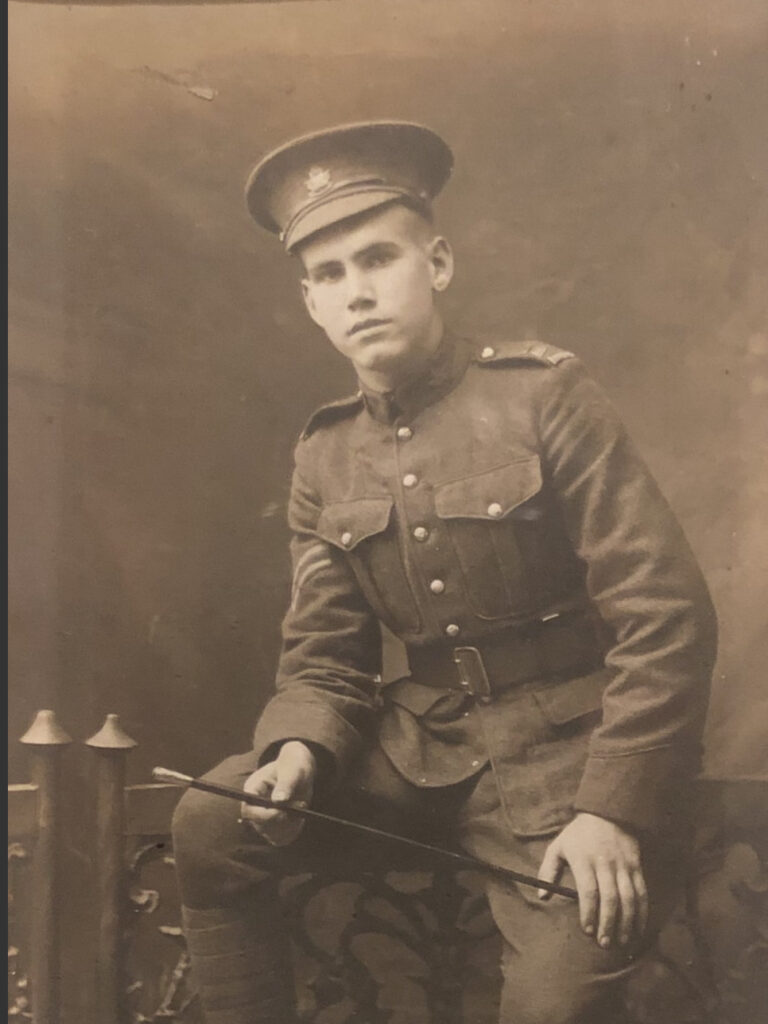
Service highlights
- Born: 21 November 1897, Stratford, Ontario.
- Enlisted: 15 November 1915 at St. Marys, Ontario (initially with the 110th (Perth) Battalion).
- Service number: 727070.
- Unit: 4th Canadian Mounted Rifles (2nd Central Ontario Regiment).
- Died: 10 September 1918, age 20.
- Burial: Terlincthun British Cemetery, Pas de Calais, France, Grave III. E. 22.
- Family: Son of John and Agnes McMaster of St. Marys, Ontario.
- Commemorated: cenotaphs at St. Marys
A Life and Service Remembered
William Earl McMaster, known to those around him as Earl, was born in Stratford and made his home in St. Marys on William Street. Before the war, he worked as a clerk in a local hardware store, the kind of steady job that quietly ties a young person to their town and their neighbours.
In November 1915, just short of his eighteenth birthday, Earl enlisted in St. Marys. He trained with the 110th (Perth) Battalion and sailed overseas in the fall of 1916. Like many Canadians who arrived in England during this phase of the war, his path became complicated by the reinforcement system. He spent time with a reserve unit and, in the small pressures of military life, he struggled at times with discipline and routine. It is easy to read those moments as simple trouble, but they also read as restlessness, a young man determined to be where he felt he belonged.
In April 1917, Earl made a choice that says a lot about him. He asked to give up his corporal stripe and revert to private so he could get to France. He was posted to the 4th Canadian Mounted Rifles and joined D Company in the Vimy sector. He served through hard fighting in 1917, including Fresnoy and Lens, and he endured the particular cruelty of gas warfare. A “white cross” shell left him badly affected and he was sent back to England to recover. He returned to his battalion in the spring of 1918.
In August 1918, during the push that became known as Canada’s Hundred Days, Earl’s unit took part in the fighting near Amiens and later moved toward Arras. On 24 August 1918, D Company was hit with a heavy concentration of “yellow cross” gas, mustard. Earl was among those evacuated, burned and blistered by the exposure. He was transferred to hospital at Boulogne, where he died on 10 September 1918.
Earl was buried at Terlincthun British Cemetery. His headstone bears words chosen by his mother: “May his reward be as great as his sacrifice.” He is also commemorated on the cenotaph in St. Marys, returned home in name, and remembered there still.
Major battles and operations
- Vimy sector (1917): Served with the 4th Canadian Mounted Rifles after volunteering to go to the front.
- Fresnoy (3 May 1917): Took part with his unit during a difficult phase of fighting in the Arras area.
- Lens (15 to 25 August 1917): Fought with the Canadian effort around Lens, then later suffered serious gas exposure in the same broader sector.
- Amiens and the opening of Canada’s Hundred Days (8 August 1918): Advanced with the Canadian Corps during the major offensive that helped break the German line.
- Arras sector (24 August 1918): Gassed by mustard gas during preparations for further attacks, leading to evacuation and death weeks later.
Learn More
- Veterans Affairs Canada, Canadian Virtual War Memorial (ID 669830):
https://veterans.gc.ca/en/remembrance/memorials/canadian-virtual-war-memorial/669830 - Canadian Great War Project (PID 66091):
https://canadiangreatwarproject.com/person.php?pid=66091 - Library and Archives Canada, First World War Personnel Records (Item 134362):
https://recherche-collection-search.bac-lac.gc.ca/eng/home/record?IdNumber=134362&app=pffww&ecopy=534897a - “The Fallen” by Richard Holt, entry for 727070 Private W.E. McMaster (page shown in your photo).
- Azzano, Mark, MASTERS 2022 (PDF):
https://library2.smu.ca/bitstream/handle/01/30909/Azzano_Mark_MASTERS_2022.pdf?sequence=1&isAllowed=y
The Fallen by Richard Holt, 727070 Private W.E. McMaster pg 44