
Canada’s “Adopt a Ship” tradition
During the Second World War, Canadians didn’t just follow the war at sea through headlines. Many communities adopted the Royal Canadian Navy ship that would carry the names of the communities that adopted them, then they raised money and organized volunteer work to make life aboard a little more livable for the ship’s company.
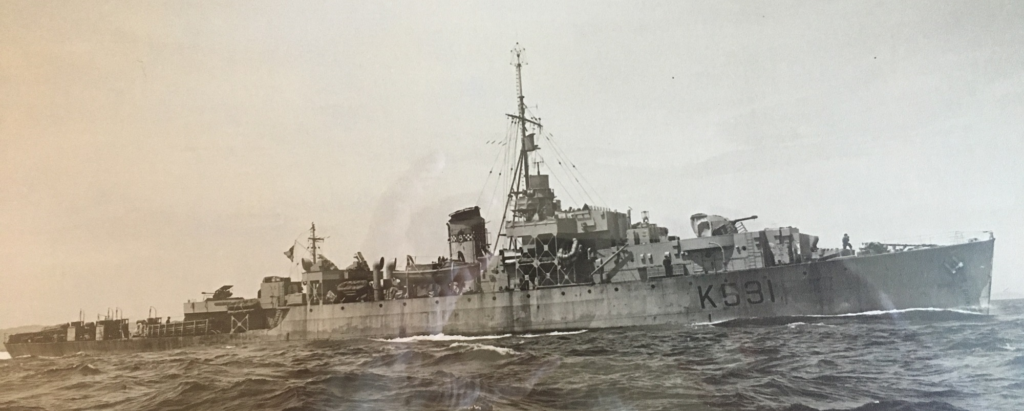
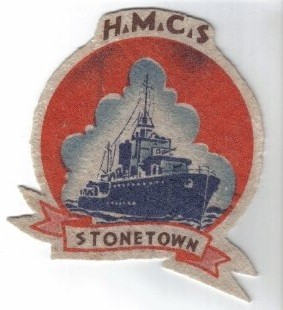
When HMCS Stone Town was commissioned at Montréal on July 21, 1944, she carried more than a pennant number. Her name was chosen using the towns nick name “Stone Town” because “St. Mary’s” was already in use elsewhere in Commonwealth navies. It was launched in a double ceremony, which set a record as the earliest launching to date on the St. Lawrence River in spring from the famous Vickers’ yards. It also was a first in the Canadian record of two naval ships going down the ways in a double launching.
David C. White, mayor of St. Mary’s J. W. Durr, Town Clerk and F. G. Sanderson, M. P. for St. Mary’s district were present for the launching. They were proud, Local committees had raised $3,000 and $4,000 (about $55,000-$75,000 of value today) for “comforts,” the extra gear and supplies for the “Stone Town”. This was an immeasurable feat coming out of a decade long depression.
Those funds could turn into things you can picture immediately aboard a crowded escort: small appliances and shop tools that helped the ship run day to day, and recreation items that helped fill the long hours off watch. The same report describes communities purchasing additional equipment and comforts not supplied through normal channels, ranging from practical items like irons or a paint sprayer to morale boosters like games and instruments.
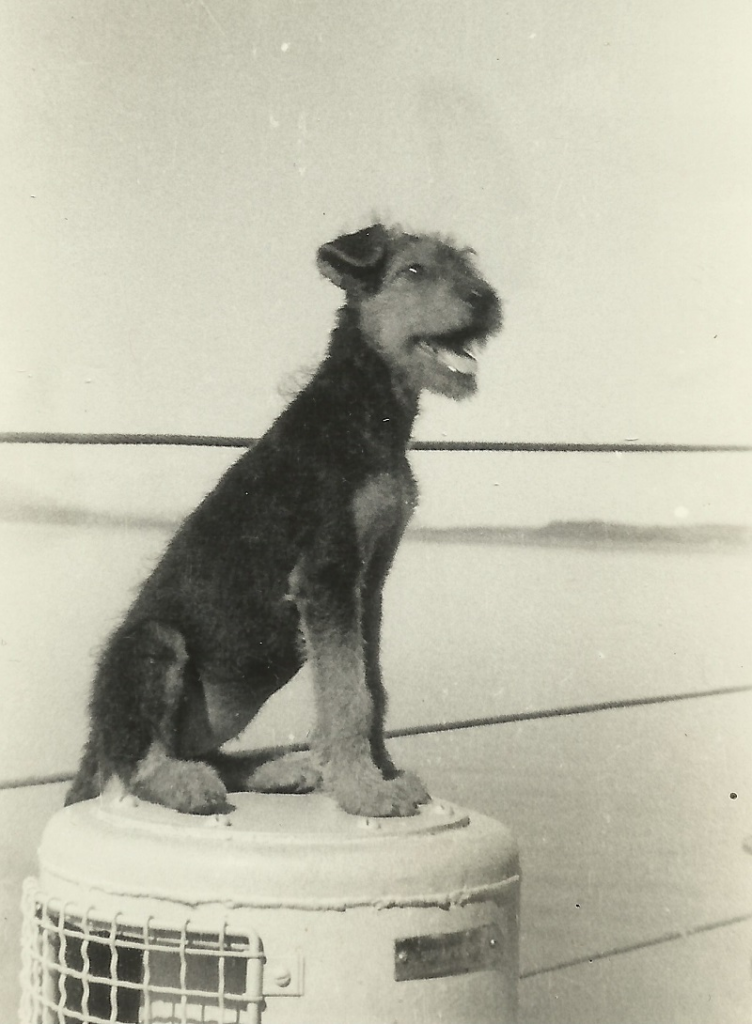
Alongside fundraising, there was a steady current of handmade support. Comfort parcels and personal kits often included basics for hygiene and correspondence, plus warmth that could not be taken for granted on the North Atlantic. Canadian Legion and Auxiliary alongside groups like the Red Cross, IODE, Women’s Institutes, Navy League, Rotary, and others supported these ships. Canadian Red Cross describes a “ditty bag” stocked with essentials and “a pair of warm hand-knit socks,” the kind of small, durable item that shows up again and again in wartime comfort work. Broader wartime “comforts” efforts also regularly meant knitted garments like socks and sweaters, produced by volunteer groups and sent overseas. Stone Town even had a mascot lovingly named “Stoney” after the ship.
Stone Town’s own service record moves quickly: arrival at Halifax in August 1944, workups in Bermuda, then mid-ocean convoy escort work as the war pushed toward its final year. But the adopted-ship relationship ran on a different clock, measured in church basements, committee meetings, donation jars, and knitted wool. The townfolk ho raised money might never see the ship in person, yet still manage to send something that ended up in a locker, a mess, or a sailor’s kit, used in ordinary moments between extraordinary ones.
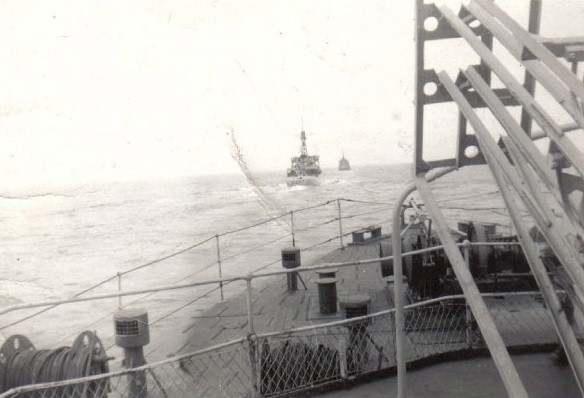
The Stone Town spent most of her wartime service as a mid-ocean convoy escort with Escort Group C-8, protecting merchant shipping on the North Atlantic routes in the final year of the Battle of the Atlantic. She carried a crew of 141, and boasted a speed of 19 knots. She carried 2 4″ (102mm), one 12 pound gun, eight 20mm guns one hedgehog motor along with depth chargers
She had only one notable incident while escorting Convoy ONS 50 on May 13, 1945, Stone Town (with HMCS Humberstone) was ordered ahead at full speed to investigate a surfaced U-boat flying a surrender flag. Stone Town circled it, confirmed it as U-244, passed surrender routing instructions, and held the situation until a Royal Navy escort arrived to take over. Then Stone Town rejoined the convoy.
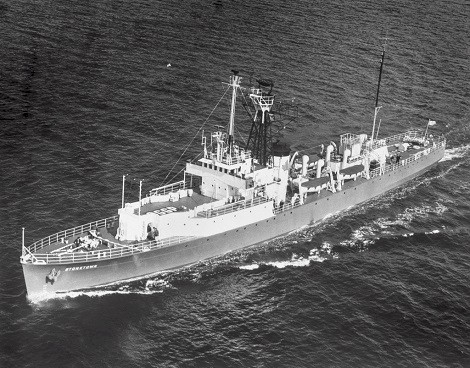
After Japan surrendered, work aboard her stopped and she was placed in reserve status at Shelburne where she sat until she was sold to the Department of Transport and converted to a weather ship in 1950, sailing to Esquimalt that October. She then served on Ocean Station Papa in the North Pacific, acting as a fixed reporting platform for weather observations and aviation support over the Pacific routes, until the purpose-built weather ships took over in 1968 when she was sold to a private company to possibly be used as a fishing vessel.
Today a dedication plaque for her is on display at the St. Marys Museum as well as images of her can be seen at the St. Marys Legion branch.