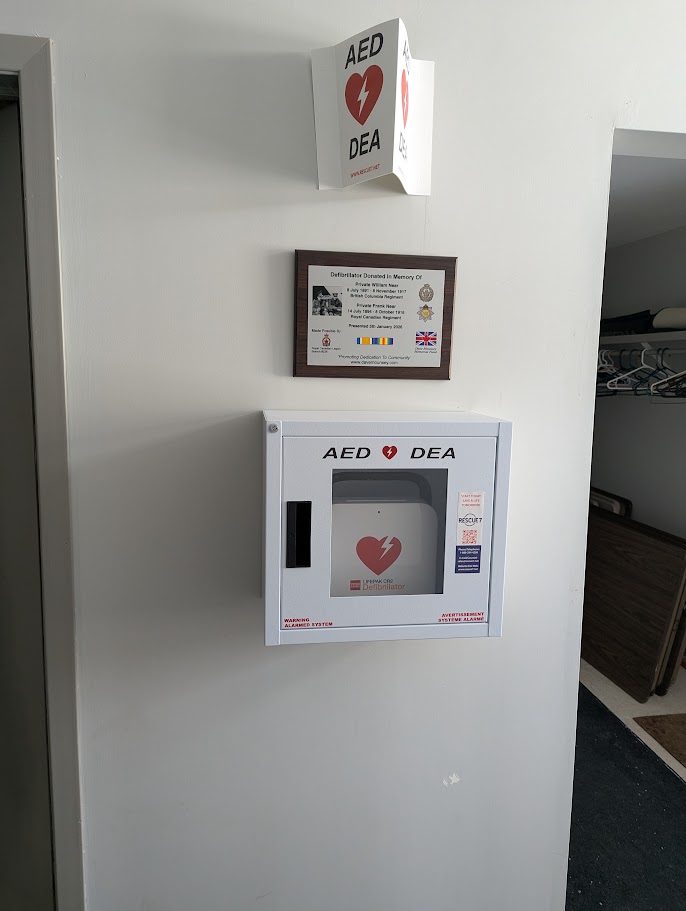
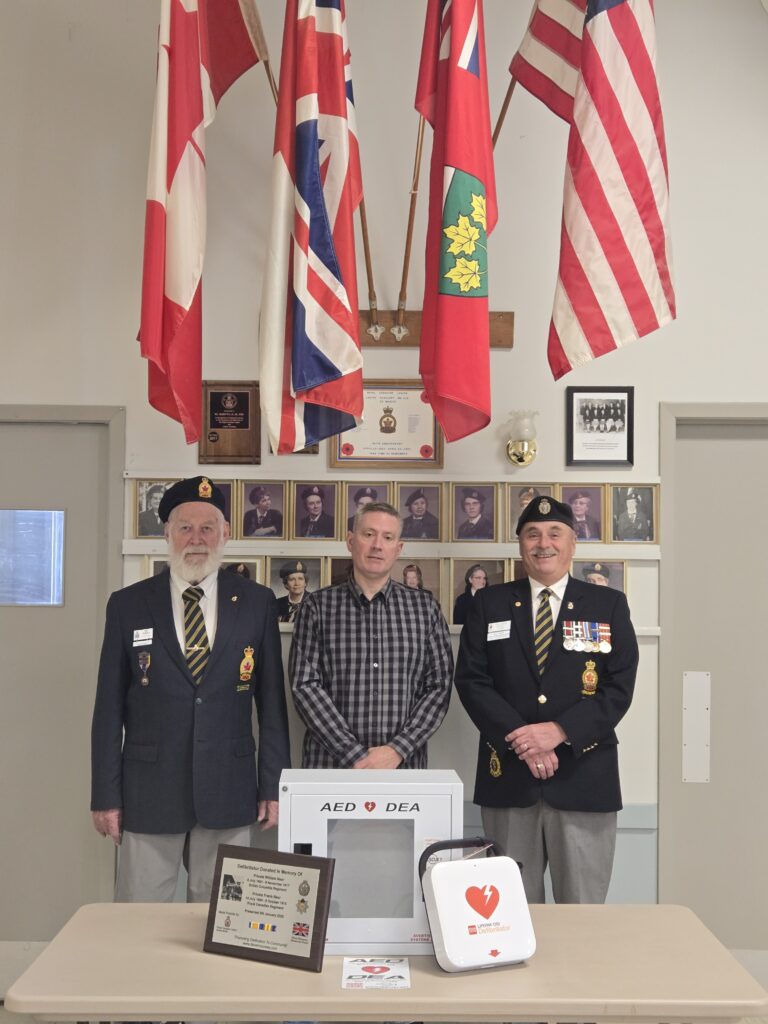
On February 14, Branch 236 of the Royal Canadian Legion in St. Marys held a dedication ceremony for an Automated External Defibrillator (AED) donated through the Dave Mounsey Memorial Fund. The device was dedicated in memory of Frank and William Near, two brothers from St. Marys whose story of service and sacrifice speaks to the personal cost carried by so many Canadian families.
Before the war, Frank worked as a barber and William as a freight agent in St. Marys. Frank enlisted on June 28, 1915, with the 33rd Canadian Infantry Battalion. William followed less than two months later, enlisting on August 16, 1915, with the same battalion in London. On April 1, 1916, they sailed together from Halifax aboard the SS Lapland, crossing the Atlantic side by side into the unknown.
Though they tried to stay together, Frank was transferred to The Royal Canadian Regiment while William was diverted to the 7th Canadian Infantry Battalion. William applied to have Frank transferred to serve alongside him, but the paperwork never went through.
On October 8, 1916, during the Battle of the Ancre Heights at the Somme in France, Frank’s unit attacked the German position. The assault fell apart when other battalions encountered uncut barbed wire. Canadian forces suffered 1,364 casualties that day and Frank Near was listed as missing. His body was never recovered, and his name is commemorated on the Vimy Ridge memorial.
William carried on. A year later, during the Third Battle of Ypres at Passchendaele in Belgium, he served as a battalion headquarters runner, carrying messages through shellfire. His last diary entry, dated November 7, 1917, mentioned cold rain and writing a letter to his mother, Mary. The next night, William was killed while moving into the assembly trenches. He was buried in Belgium, but the location of his grave is lost to history. His name is inscribed on the Menin Gate in Ypres among the 54,000 missing.
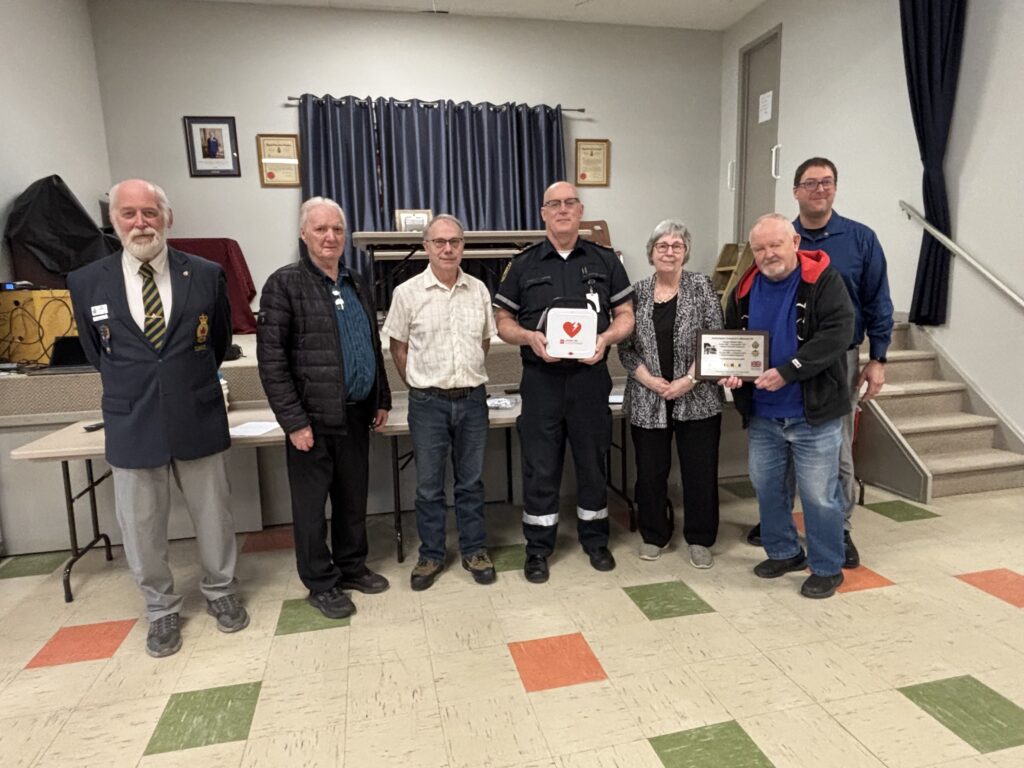
It was this history that brought a small group together on Valentine’s Day. The ceremony was attended by Scott Rutherford of Perth County Paramedic Services, who demonstrated the AED and explained the Public Access Defibrillation program; Reg Rumble, Branch President; Mike Rumble, Veteran Services Officer; and relatives of the Near family.
The Dave Mounsey Memorial Fund was established by OPP Sergeant Patrick Armstrong in honor of Provincial Constable Dave Mounsey, who died in the line of duty in 2006. It donates AEDs to public buildings in memory of fallen law enforcement, fire, EMS, and military members. To date, the Foundation has donated 242 defibrillators, saving seven lives.
“Frank and William Near gave everything,” said Mike Rumble during the ceremony. “The Near brothers couldn’t come home. But because of them, and because of the Dave Mounsey Foundation, someone else can.”
The AED is now available for public use at the Legion.
A photo from the January delivery includes Patrick Armstrong and Tom Jenkins (Zone Service Officer) and Reg Rumble (Branch President). A photo from the February dedication ceremony features Mike Rumble (Branch Service Officer), Reg Rumble, Scott Rutherford, and representative of the Near family.
International Women’s Day is a chance to celebrate women today, and it is also a chance to remember the women who carried our communities through wartime.
When we picture service, we often picture the men who enlisted and fought overseas. Many of their details were carefully recorded and preserved, and we are grateful for that. But for many women, the paper trail is thinner. Their work was sometimes documented less fully, filed differently, or not kept with the same care. That gap does not mean their service mattered less. It means we have to work harder to protect their stories now.
Through our Legion’s Banner Program, Families and Branch 236 has been able to honour and recognize those women connected to our community, who stepped forward when it counted. Women who served in uniform, in the air services, in medical roles, and in vital support trades. Women also served on the home front in ways that kept the entire war effort moving, including essential agricultural work, production, and community support. These roles were not secondary. They were necessary.
We are especially grateful to the families who have helped make this recognition possible. Bessie (Strathdee) Heaslip was remembered for her service in the Royal Canadian Air Force Women’s Division, where she met Leading Aircraftman Charles Heaslip and later boasted they were the first couple on their base to be married in uniform. Winifred (Stark) Maciver was honoured for her work with the Women’s Land Army, part of the essential “home front” workforce that kept farms running while so many men were overseas. Corporal Alice Barnett (Laurnitus), Flight Sergeant Isobel McCauley were honoured through the sponsorship of their family.
Eve Sherwin & Lieutenant Daisy Gavin (Harris) are remembered in our community as Nursing Sister’s, a role that carried both skill and quiet courage. First Lieutenant Marie Pyne is remembered locally for service as an Army nurse. Sergeant Majorie Boucher (Hicks), Private Agnes “Nesie” Houston served in an air force role connected to Great Britain and Scotland. Elsie Heinbuck served with the Canadian Womens Army Corps These family sponsorships are acts of Remembrance in their own right, and they help ensure these stories stay visible in the place they belong, in our community.
If you have photos, letters, service details, or family stories connected to any of the women honoured through our Banner Program, we would love to hear from you. Every detail helps us preserve these histories properly, as lives remembered, not just names. This year, as we commemorate the Royal Canadian Legion’s 100th anniversary, this is part of our ongoing work to memorialize the names connected to our local remembrance efforts.
Behind each banner is a real person. A neighbor. A daughter. A sister. Someone who carried responsibility quietly, often without the recognition they deserved at the time. Putting their names and service into the public view is one way we can say, we see you, and we remember. as we
During the Second World War, Canadians didn’t just follow the war at sea through headlines. Many communities adopted the Royal Canadian Navy ship that would carry the names of the communities that adopted them, then they raised money and organized volunteer work to make life aboard a little more livable for the ship’s company.
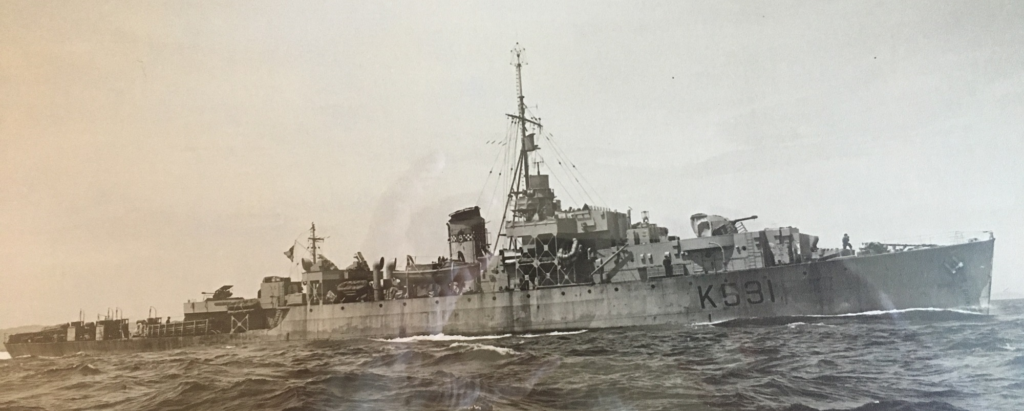
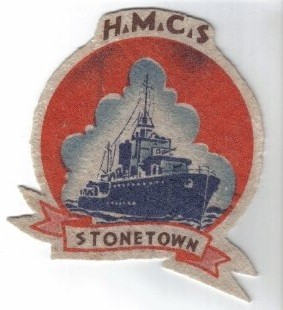
When HMCS Stone Town was commissioned at Montréal on July 21, 1944, she carried more than a pennant number. Her name was chosen using the towns nick name “Stone Town” because “St. Mary’s” was already in use elsewhere in Commonwealth navies. It was launched in a double ceremony, which set a record as the earliest launching to date on the St. Lawrence River in spring from the famous Vickers’ yards. It also was a first in the Canadian record of two naval ships going down the ways in a double launching.
David C. White, mayor of St. Mary’s J. W. Durr, Town Clerk and F. G. Sanderson, M. P. for St. Mary’s district were present for the launching. They were proud, Local committees had raised $3,000 and $4,000 (about $55,000-$75,000 of value today) for “comforts,” the extra gear and supplies for the “Stone Town”. This was an immeasurable feat coming out of a decade long depression.
Those funds could turn into things you can picture immediately aboard a crowded escort: small appliances and shop tools that helped the ship run day to day, and recreation items that helped fill the long hours off watch. The same report describes communities purchasing additional equipment and comforts not supplied through normal channels, ranging from practical items like irons or a paint sprayer to morale boosters like games and instruments.
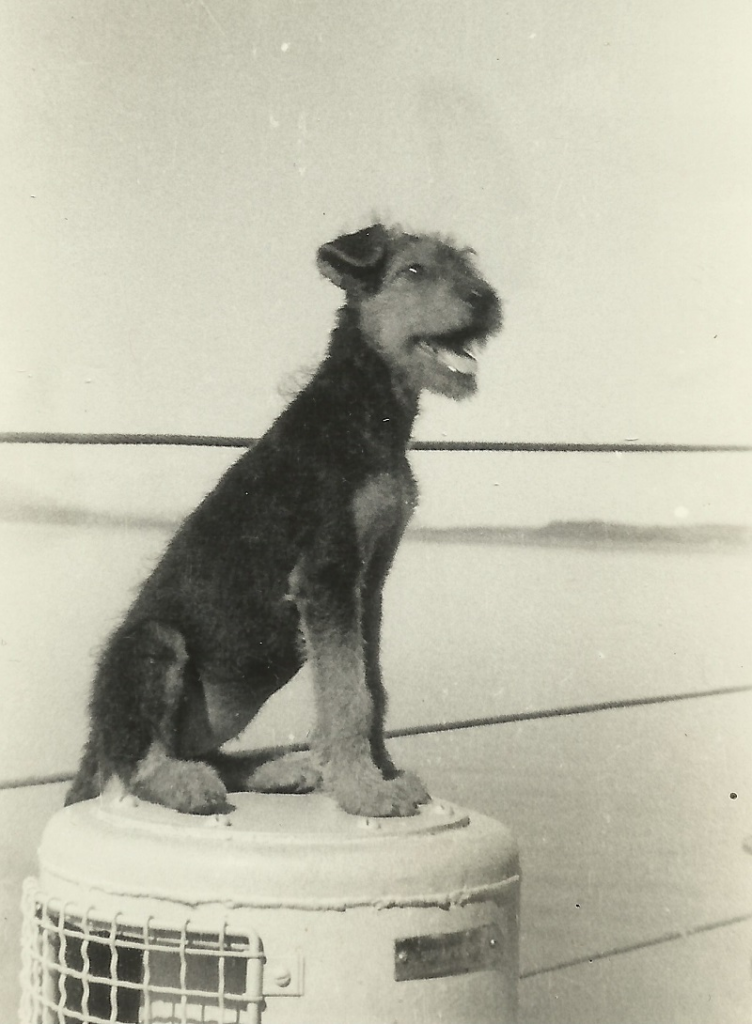
Alongside fundraising, there was a steady current of handmade support. Comfort parcels and personal kits often included basics for hygiene and correspondence, plus warmth that could not be taken for granted on the North Atlantic. Canadian Legion and Auxiliary alongside groups like the Red Cross, IODE, Women’s Institutes, Navy League, Rotary, and others supported these ships. Canadian Red Cross describes a “ditty bag” stocked with essentials and “a pair of warm hand-knit socks,” the kind of small, durable item that shows up again and again in wartime comfort work. Broader wartime “comforts” efforts also regularly meant knitted garments like socks and sweaters, produced by volunteer groups and sent overseas. Stone Town even had a mascot lovingly named “Stoney” after the ship.
Stone Town’s own service record moves quickly: arrival at Halifax in August 1944, workups in Bermuda, then mid-ocean convoy escort work as the war pushed toward its final year. But the adopted-ship relationship ran on a different clock, measured in church basements, committee meetings, donation jars, and knitted wool. The townfolk ho raised money might never see the ship in person, yet still manage to send something that ended up in a locker, a mess, or a sailor’s kit, used in ordinary moments between extraordinary ones.
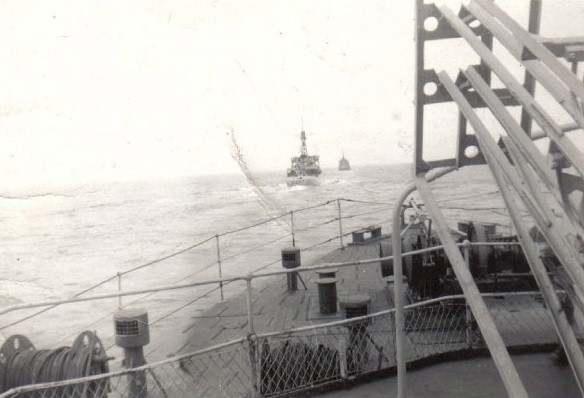
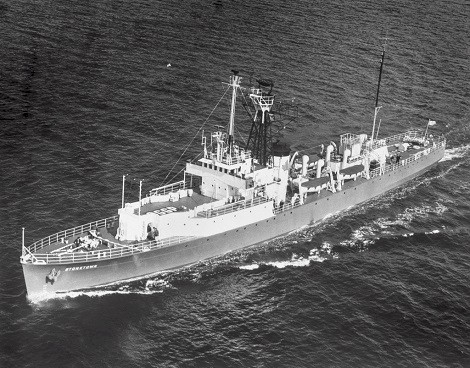
The Stone Town spent most of her wartime service as a mid-ocean convoy escort with Escort Group C-8, protecting merchant shipping on the North Atlantic routes in the final year of the Battle of the Atlantic. She carried a crew of 141, and boasted a speed of 19 knots. She carried 2 4″ (102mm), one 12 pound gun, eight 20mm guns one hedgehog motor along with depth chargers
She had only one notable incident while escorting Convoy ONS 50 on May 13, 1945, Stone Town (with HMCS Humberstone) was ordered ahead at full speed to investigate a surfaced U-boat flying a surrender flag. Stone Town circled it, confirmed it as U-244, passed surrender routing instructions, and held the situation until a Royal Navy escort arrived to take over. Then Stone Town rejoined the convoy.
After Japan surrendered, work aboard her stopped and she was placed in reserve status at Shelburne where she sat until she was sold to the Department of Transport and converted to a weather ship in 1950, sailing to Esquimalt that October. She then served on Ocean Station Papa in the North Pacific, acting as a fixed reporting platform for weather observations and aviation support over the Pacific routes, until the purpose-built weather ships took over in 1968 when she was sold to a private company to possibly be used as a fishing vessel.
Today a dedication plaque for her is on display at the St. Marys Museum as well as images of her can be seen at the St. Marys Legion branch.
At Royal Canadian Legion Branch 236 in St. Marys, we spend a lot of time thinking about how national history becomes local memory. As the Legion marks 100 years since its 1926 incorporation, we are bringing stories like this forward so the next generations will continue to remember these names, and to understand what these men were asked to give, and what they died for.
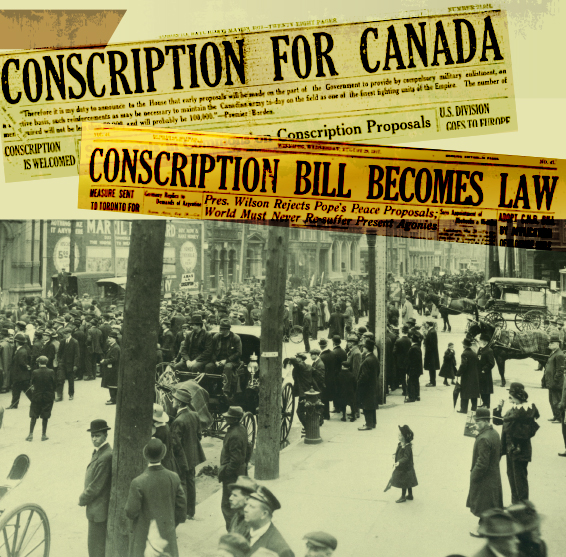
It is easy to tell the story of Canada’s 1917 conscription crisis as something that happened far away, in Ottawa, in newspaper headlines, in speeches and votes. Here in St. Marys, we live with that history in a more direct way. At the Legion, we stand in the shadow of our cenotaph, on November 11th we read the names, and we help carry the stories forward. When we talk about conscription, we are not talking about theory. We are talking about consequences that reached this town and stayed.
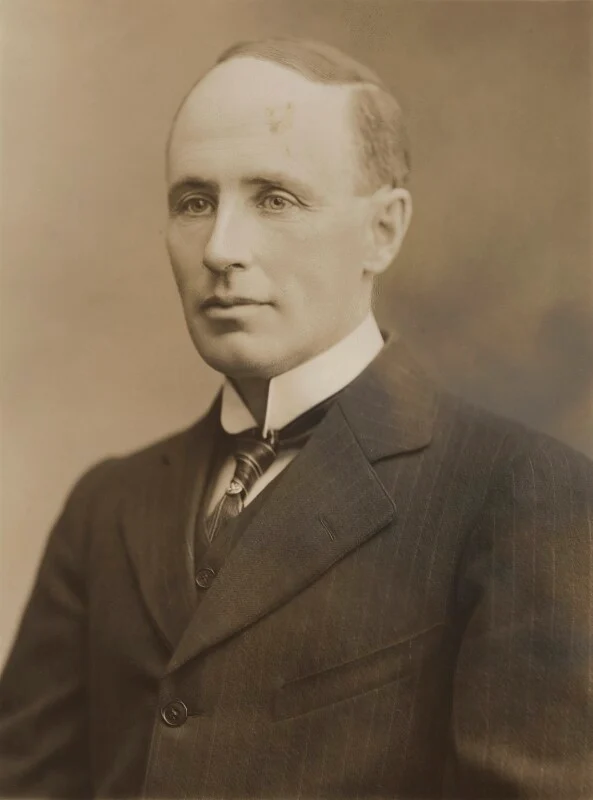
One of the principal architects of conscription was shaped right here. Arthur Meighen was born on June 16, 1874, in the hamlet of Anderson, located in Blanchard Township near St. Marys, Ontario and educated at St. Marys Collegiate right here in St. Marys. He later became one of the most forceful voices of his generation, and a prime minister. His national story still loops back to this town in a literal way, since his statue stands proud in the Park that bears his name, and he is buried at the St. Marys Cemetery.
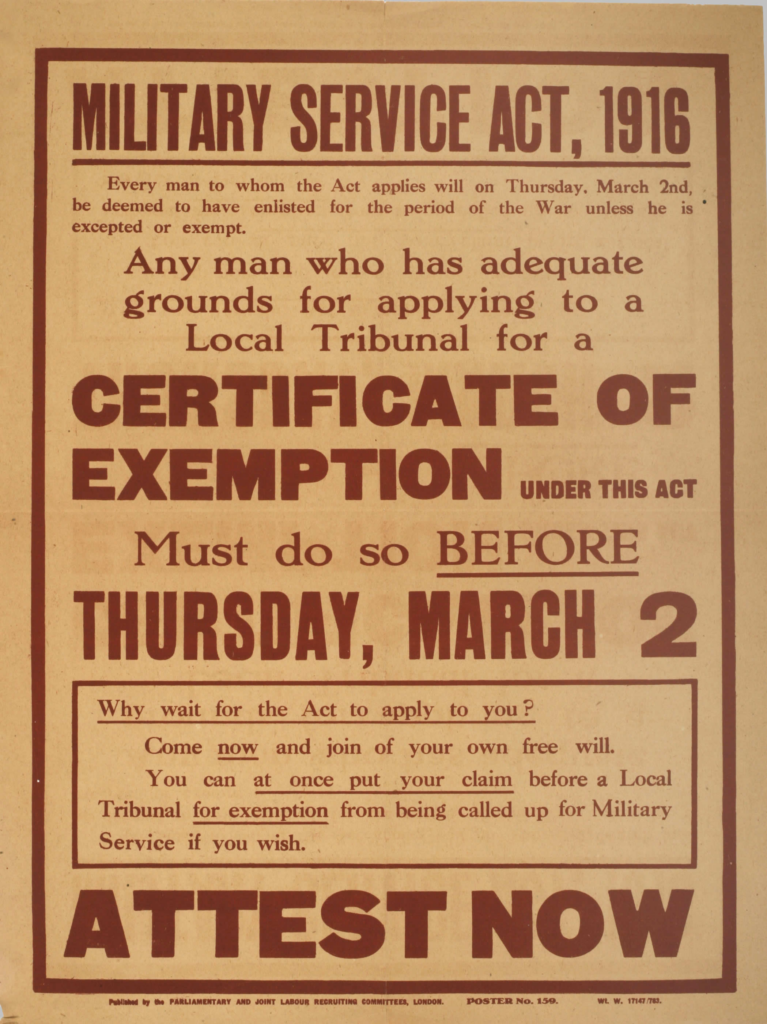
By 1917, the voluntary enlistment system was failing to maintain troop numbers. Arthur Meighen was asked to draft the Military Service Act. In this act the federal government decided to conscript young men for overseas military service. Meighen’s pro-conscription case can still be read in the text of his June 1917 speech. It is worth revisiting because it shows the tone and logic of the argument, before later retellings softened the edges. One line captures the moral frame he chose: “The obligation of honour is upon us.” The Military Service Act became law on August 29, 1917. Orders soon followed. On October 13, 1917, unmarried men (or widowers) aged 20 to 24 were ordered to report locally for medical assessments, and exemption requests became widespread.
This is where “Ottawa” stops being a location and becomes a system that reaches into every town. Once a reporting order exists, it reaches factory floors, farms, boarding houses, and family kitchens. It reaches young men whose futures were already uncertain, and it reaches parents and spouses who had no vote in the choice but lived with the outcome.
The result was not simply political disagreement. Conscription produced one of the fiercest and most divisive periods in Canadian public life. The lines of conflict ran through language and region, but also through occupation and class. Opposition was particularly strong in Quebec City, and resistance escalated into several days of rioting and street battles at Easter 1918, leaving four civilians dead and many more injured.
In towns like St. Marys, conscription was not just policy the consequences are written in stone at St. Marys Cenotaph. Among those sixty-five names, research identifies three men recorded as having entered service through conscription and then dying in uniform. Their stories are local proof that wartime decisions did not stay theoretical. The law was argued nationally by a local man came back and forever changed families here.
The first is Archie Alexander Kemp. Our cenotaph research records Kemp as drafted into the 1st Depot Battalion at Stratford on January 4, 1918, and dead by January 28, 1918 at Kirton, Ontario. This is conscription at its starkest. The draft reaches into a small community, and the loss lands almost immediately, close to home, before an overseas posting could even become part of the story.
The second is Norman Theodore Hopkin. Our cenotaph research records Hopkin as drafted under the Military Service Act on January 23, 1918 into the 1st Depot Battalion at Stratford. It then traces him overseas with the 18th Battalion, wounded on August 27, 1918, and dead on September 10, 1918. His path is what many people imagine when they picture the Great War: the front, the wound, and death overseas. What St. Marys adds, through the cenotaph record, is the origin point. He did not enter through volunteering. He entered through the draft.
The third is William Wood. Our cenotaph research records Wood as drafted into the 1st Depot Battalion at Stratford on October 26, 1917. It also records his death as influenza on October 23, 1918 at a Canadian hospital at Kinmel Park Camp in North Wales, with burial at St. Margaret’s Churchyard, Bodelwyddan. Wood’s case matters for another reason. It underlines how the cost of conscription is not only battlefield death. By late 1918, the war’s machinery was also funneling men into overcrowded camps and hospitals during the influenza wave. In that sense, the draft did not just send men toward combat. It also placed men into vulnerable spaces where disease could finish what the war began.
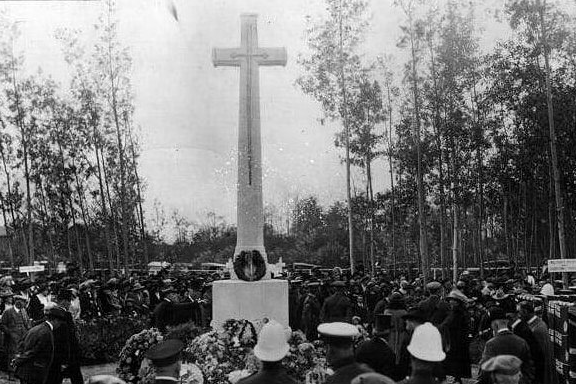
By 1921, the country was actively shaping how it would remember the sacrifices. In July of that year, now Prime Minister Meighen travelled to Vimy Ridge and delivered a major tribute to the Great War dead at the unveiling of the Cross of Sacrifice at Thelus Military Cemetery. One line stands out because it is plain, specific, and difficult to evade: “At this time, the proper occupation of the living is, first, to honour our heroic dead.” In the same speech, he reached for an image of connection across distance and time: “Across the leagues of the Atlantic the heartstrings of our Canadian nation will reach through all time to these graves in France.”
Four months later, St. Marys made its own public choice about remembrance. On November 7, 1921, The town unveiled its cenotaph beside Town Hall and carved sixty-five names into its sides. It was funded by the Women’s Institute, For us, honouring the dead is not abstract but community work and determination. It stands as list of names in public view, but it is noticing the details inside those names, including the three who entered service through conscription and did not come home.
After the war, the country faced another obligation: what came next for the living. A later profile of Meighen notes that he oversaw an initiative designed to assist financially those veterans who wished to become farmers. In practice, returned soldiers could be supported through programs aimed at land settlement, with provisions tied to land, livestock, and farm equipment. However imperfect those programs were in real life, it shows the state trying, at least on paper, to answer a hard question: what does a country owe the people it sent?
Veterans’ organizations were also consolidating into a national body in the mid-1920s. On July 17, 1926, the Canadian Legion of the British Empire Service League was incorporated under federal authority through letters patent under the Companies Act. That date falls during Meighen’s brief second term as prime minister, but the incorporation paperwork itself was handled through the Secretary of State’s department, so it is best understood as something that occurred under his government rather than a personal act. Later, the organization was formally incorporated by a federal Act in 1948, and its name was updated in later amendments.
That is part of why this history belongs at a Legion branch. We are not repeating it to reopen old arguments, or to reduce complex politics to a single villain or hero. We are carrying it forward because it connects directly to our town, our memorial, and the families who still see their own names reflected in those carved letters. As we mark 100 years, we want the next generations to remember these men as more than names on stone. We do that by keeping the record straight, by speaking plainly about how men entered service, and by returning, again and again, to the cenotaph, to the plaques on town hall, to the banners placed around town every year. Not as an artifact, but as a promise: the families of those who served will be remembered locally, with care, accuracy, and respect Remembering is not passive. It is work. It is telling the truth carefully, and then making sure it is not forgotten.