
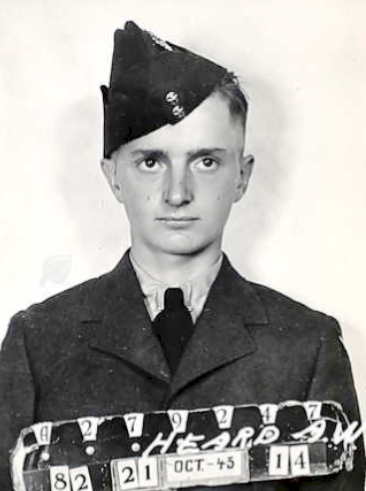
Service highlights
- Service Number: R279247
- Born January 1, 1926 in St. Marys, Ontario.
- Enlisted with the Royal Canadian Air Force at London on October 18, 1943.
- Trained as a wireless operator and air gunner, including Wireless School at St. Thomas and multiple gunnery schools in Canada.
- Sailed to England on July 11, 1944, then posted to an operational training unit and 1666 Heavy Conversion Unit, training on Lancaster bombers.
- Killed on February 10, 1945 in a training crash near South Cerney while flying in Lancaster ME750.
- Buried at Brookwood Military Cemetery, grave 56.H.7.
- Commemorated on the Rannoch cenotaph and the World War II plaque on the south wall of St. Marys Town Hall.
A Life and Service Remembered
Alvin Walter Heard was born in St. Marys on January 1, 1926. He attended St. Marys Collegiate Institute, leaving school at 16 in 1942, preferring working as a farm hand workin on a nearby farm for Mr. J.H. Sparling near Anderson in Blanshard Township.
He enlisted in the Royal Canadian Air Force at London on October 18, 1943. After basic training at 1 Manning Depot, he trained in signals and gunnery roles that would place him in an aircrew. His wartime training path took him through Wireless School at St. Thomas (January 31 to April 9, 1944), then to bombing and gunnery instruction at Mount Pleasant, Prince Edward Island. After graduation he was promoted to sergeant and continued advanced training as a wireless operator and air gunner at additional schools in Manitoba and Quebec.
On July 11, 1944, Sergeant Heard sailed to England. He was posted first to an operational training unit, where he met the crew he would train with, and then to 1666 Heavy Conversion Unit for familiarization training on the Lancaster heavy bombers. Early in 1945, that crew was approaching the final phase of training, the kind of flight meant to prepare them for posting to an operational squadron.
On February 10, 1945, Flying Officer Herbert George Christie and his crew were scheduled for a final training flight before entering the war. The crew’s tail gunner reported sick that morning and could not fly, and Alvin volunteered to take his place. Around 3 p.m., near South Cerney, ground observers saw Lancaster ME750 emerge from the clouds in a spin and dive straight into the ground. The crew were killed on impact. Investigators later ruled the accident was likely caused by the wings becoming coated with ice in cloud, and dismissed reports that the aircraft had been on fire.
Alvin was buried in Brookwood Military Cemetery in Surrey. His headstone bears the epitaph chosen by his parents: “Safe in the arms of Jesus.” He was the son of Mervin Heard and Hazel Sparling Heard. His family also included siblings with their own wartime and home front roles: Arthur Heard (a lance corporal in the Provost Corps), Ruth Heard (serving with the RCAF Women’s Division), Kathleen Heard (nursing in London), Velma Heard (working at Maxwell’s), and Raymond Heard, Russell Heard, and William Heard at home. Bill was seven years old when his brother died. Family memory in the account recalls a winter storm that left the Anderson farm snowed in, and the sight of an RCAF officer walking through the snow up the lane, a moment Alvin’s parents recognized before a word was spoken.
The crew lost with Alvin in Lancaster ME750 are remembered together:
- Pilot: Earl Douglas Tait (J/39632)
- Navigator: Herbert George Christie (J/41488)
- Wireless operator: Arnold Joseph Snetsinger (J/44733)
- Bomb aimer and front gunner: Kenneth Mark Pridham (J/40515)
- Rear gunner: William Henry Matheson (J/45935)
- Flight engineer: Donald Gordon MacKenzie (RAFVR 1825949, as provided)
- Mid upper gunner: Sergeant Alvin Walter Heard (R/279247)
In recent years, a person researching the crash site in Gloucestershire reached out seeking relatives, hoping to place a memorial at the spot where the aircraft came down. Alvin’s story, and the story of the crew he trained and flew with, remains part of that ongoing act of remembrance.
Major battles and operations
- Alvin’s service, as recorded here, was focused on aircrew training and conversion to Lancaster aircraft in England.
- He was killed during a training navigation exercise before the crew could be posted to an operational squadron.
Learn more
- https://www.veterans.gc.ca/en/remembrance/memorials/canadian-virtual-war-memorial/718168
- https://recherche-collection-search.bac-lac.gc.ca/eng/home/record?idnumber=15370&app=kia&ecopy=44485_83024005506_0969-00001
- The Fallen by Richard Holt, R279247 Sergeant AW Heard pg 104