
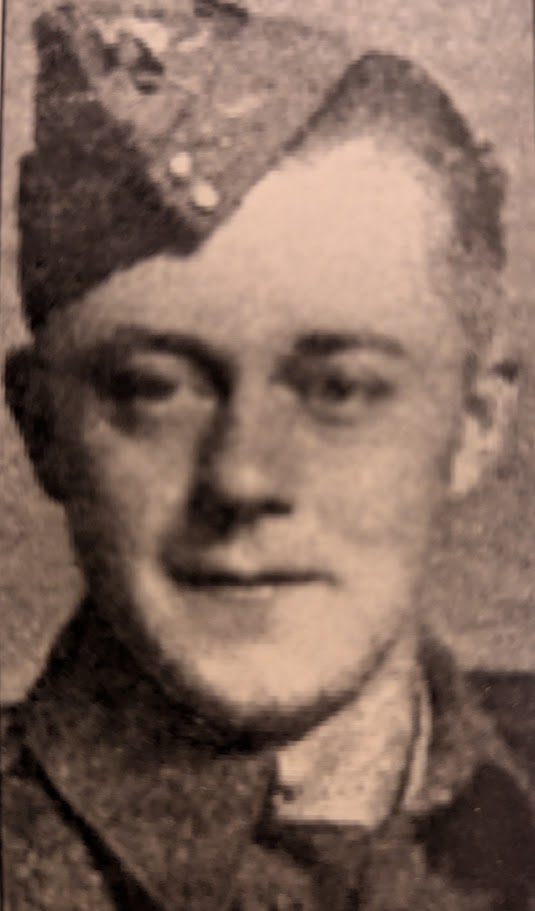
Service highlights
- Service number: A32125
- Rank: Gunner
- Born: 6 May 1919 near Granton
- Early life: Completed Grade 8 in 1934, then worked on his father’s farm
- Enlisted: 10 September 1939 in the Royal Canadian Artillery at London
- Initial training and unit: 12th Field Battery, basic training at Wolseley Barracks
- Posted in Canada: Canadian Artillery Training Centre, then the 100th Light Anti-Aircraft Battery on 27 June 1940, later the 69th Light Anti-Aircraft Battery
- Overseas: Sailed to England in July 1941, joined 3 Canadian Artillery Reinforcement Unit on arrival
- Subsequent regimental postings:
- 4th Light Anti-Aircraft Regiment, 18 December 1942
- 7th Light Anti-Aircraft Regiment, 4 August 1943
- 2nd Anti-Tank Regiment, 17 March 1944
- Killed in action: During fighting in Normandy in late July 1944
- Burial: Bretteville-sur-Laize Canadian War Cemetery
- Family: Survived by his parents, George and Neva Lambourn of Granton, his sister Corporal May Lambourn serving with the Royal Canadian Air Force, and a brother, John
- Commemorated: Listed as W. Lambourne on the World War II plaque at St. Marys Town Hall
A Life and Service Remembered
William Thomas Lambourn was born near Granton on 6 May 1919 and grew up with the rhythms of rural life. He finished school through Grade 8, then went to work on his father’s farm. That background shows up again and again in stories like his, steady responsibility, early mornings, and the kind of persistence that does not need attention to be real.
He enlisted in the Royal Canadian Artillery in London on 10 September 1939 and trained at Wolseley Barracks with the 12th Field Battery. From there, his service became a series of quick postings as Canada built and reshaped units for the war. He moved through training and anti-aircraft assignments, including a posting to the 100th Light Anti-Aircraft Battery in June 1940, before sailing to England in July 1941.
In Britain he joined a reinforcement unit, then was posted through several artillery regiments as the war’s needs shifted. By March 1944 he was with the 2nd Anti-Tank Regiment, part of the artillery supporting the 2nd Canadian Division. Their job was to stop enemy armour on the divisional front, often under chaotic conditions where getting guns forward was as dangerous as firing them.
In early July 1944 the division crossed the Channel and landed in Normandy. Later that month, during Operation Spring, the fighting became confused and brutal. The operation is remembered for the heavy losses suffered by Canadian infantry units, and for the peril faced by support troops trying to move guns into position under fire and through minefields. In the midst of that violent, uncertain fighting, Gunner Lambourn was killed in action.
He was buried in the Bretteville-sur-Laize Canadian War Cemetery in Normandy. At home, he was mourned by his parents George and Neva, his sister May, who was also in uniform, and his brother John. In St. Marys, he is remembered on the Town Hall plaque as W. Lambourne, a small variation in spelling that still points back to the same young man from Granton who did his duty far from home.
Major battles and operations
- Home front artillery buildup (1939 to 1941): Training and anti-aircraft postings in Canada as units expanded and reorganized
- Overseas service in England (from July 1941): Reinforcement service and postings through light anti-aircraft regiments
- 2nd Anti-Tank Regiment role (from March 1944): Anti-armour support for the 2nd Canadian Division, using 17-pounder guns, including towed guns that were difficult to move and conceal
- Normandy landings and operations (July 1944): The division landed in Normandy on 5 July 1944 and later fought in Operation Spring
- Operation Spring (25 July 1944): Fighting toward Verrières and May-sur-Orne, then toward Rocquancourt and Fontenay-le-Marmion, with severe losses and minefield dangers during attempts to move anti-tank guns forward
Learn More
- Vancouver Gunners, Normandy tribute
https://www.vancouvergunners.ca/whats-new/normandy-tribute - Vancouver Gunners, archives May 2020
https://www.vancouvergunners.ca/whats-new/archives/05-2020 - The Fallen, by Richard Holt, Gunner W.T. Lambourn, pg 110