
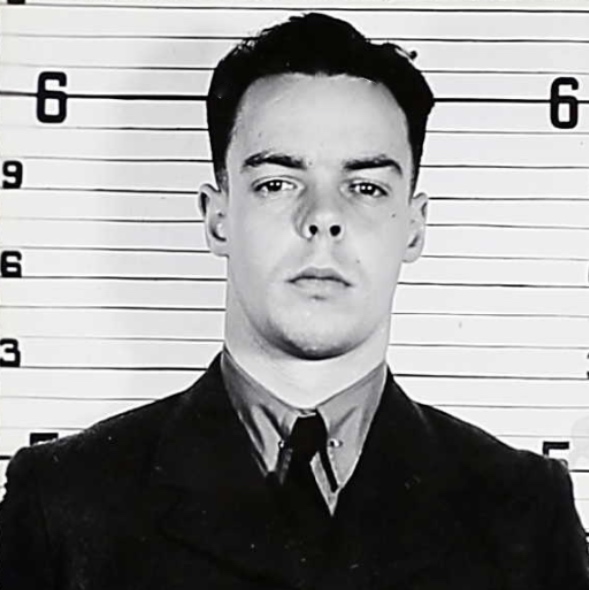
Service highlights
- Service number: J/85631
- Born 19 November 1922 in Toronto
- Raised in Port Credit
- Enlisted with the Royal Canadian Air Force in fall 1941
- Trained in Canada, then sent overseas to England on 9 March 1943
- Pilot with No. 166 Squadron RAF flying an Avro Lancaster Mk I
- Commissioned as Pilot Officer on 22 March 1944
- Killed in action on 28 April 1944 during an operation to Friedrichshafen, Germany
- Flying Lancaster ME720, which crashed at Hämikon
- Buried at Vevey (St Martin’s) Cemetery
- Commemorated on the World War II plaque at St. Marys Town Hall
A Life and Service Remembered
Robert Burns Ridley was born in Toronto on 19 November 1922. While still a boy, he moved with his family to Port Credit, where he grew up and went to school. He had a strong academic streak and studied mathematics and physics at University of Toronto. Before the war, he worked briefly at Goodyear Limited and at the Long Branch Arms Factory, like so many young Canadians whose working lives were shaped by a world at war.
A local newspaper remembered him as a Port Credit boy through and through, and also as an athlete, prominent in rugby and basketball. Robert enlisted in the fall of 1941 in Toronto. His training though was delayed and he began in March of 1942. When he graduated May 22 he was promoted to Leading Aircraftman and so he was selected for for flight training school and transferred to Centralia. He completed his training Feb 9 1943 and was promoted to Sergeant before traveling overseas toe England on March 9 1943.
His career overseas was full of momentum. He took more training and by the time he joined the 166 Bomber Squadron he had been promoted to flight Sergeant, and shortly after that Warrant Officer Class II. Despite his momentum he never forgot his roots and took time to write letters home. His mother received one of these letter from him, written April 21 while he was on leave in London, only an hour before she received word that he was missing. It is the kind of moment families never forget, a final ordinary piece of mail arriving right before the world changes.
He had joined 166 Squadron in February 1944, on April 28th they took off from Kirmington for an operation against Friedrichshafen. When they were near the target, the aircraft was hit by anti-aircraft fire and the starboard wing caught fire. Ridley stayed at the controls to keep the plane steady long enough for two crewmates to bail out of the plane. He stayed and the other 4 crew members did not manage to escape and were killed on impact as the Lancaster ME720 crashed in Switzerland at Hämikon. The two crew members who bailed out survived and were captured. They were interned in Switzerland and survived the war.
He was survived by his parents, Arthur and Annie Florence Ridley of Port Credit, and by his grandmother, Annie Birch of St. Marys. Today, his name remains close to home on the St. Marys Town Hall World War II plaque.
Major battles and operations
Training in Canada
- Enlisted in fall 1941 and began the long training pipeline as capacity allowed
- 1 Initial Training School in Toronto, 29 March to 22 May 1942
- Selected for flight training, including 12 Elementary Flying Training School
- Posted to 9 Service Flying Training School at Centralia, with training completed in February 1943
Overseas training and bomber operations
- Sent to England on 9 March 1943
- Further training with 30 Operational Training Unit and 1667 Heavy Conversion Unit
- Joined 166 Squadron in February 1944, flying Lancaster bombers on operations over occupied Europe
- Commissioned Pilot Officer on 22 March 1944
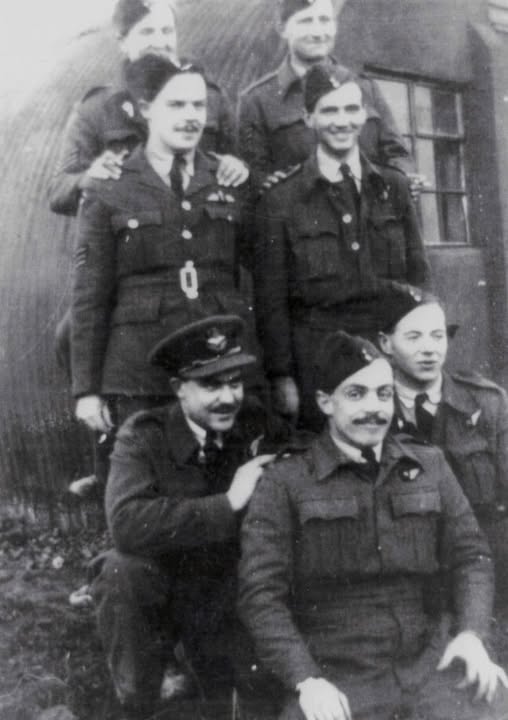
Crew of Lancaster ME720 (as recorded in the aircraft loss record)
- Pilot: Pilot Officer Robert Burns Ridley, RCAF (killed)
- Flight Engineer: Sgt John James Eaton, RAFVR (killed)
- Navigator: Flying Officer Albert C Piggott, RCAF (interned)
- Bomb Aimer: Flying Officer Roy E A Phillips, RAF (interned)
- Wireless Operator: Sgt Leslie Cotton, RAFVR (killed)
- Mid Upper Gunner: Sgt Ross Lewis Clark, RAFVR (killed)
- Rear Gunner: Sgt Allan Mackay Weir, RAFVR (killed)
Learn More
- Canadian Virtual War Memorial
https://www.veterans.gc.ca/en/remembrance/memorials/canadian-virtual-war-memorial/669761 - CASPIR unit search
https://caspir.warplane.com/personnel/unit-search/p/600017075 - Commonwealth War Graves Commission record
https://www.cwgc.org/find-records/find-war-dead/casualty-details/2806327/robert-burns-ridley/ - Aviation Safety Network, Lancaster ME720 loss record
https://aviation-safety.net/wikibase/237843 - Aircrew Remembered, incident search for ME720
https://aircrewremembered.com/AlliedLossesIncidents/?q=ME720&qand=&exc1=&exc2=&search_only=&search_type=exact - Robert Ridley Project44 page
https://robert-ridley.project44.ca/ - RAF 166 Squadron page, Missing Ridley
https://www.raf166squadron.com/MissingRidley.htm - The Fallen by Richard Holt, Pilot Officer R.B. Ridley J85631