
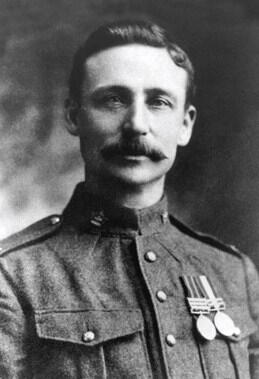
Service Highlights
- Service Number: 57113
- Born September 23, 1873 in London, England.
- Son of John Philip Hobson and Sarah Wallace Hobson.
- Served with the 2nd Battalion, Wiltshire Regiment, British Army during the South African War, reaching the rank of Corporal.
- Emigrated to Canada in 1904 with Louisa Alice Esther Moses and later settled in Galt, Ontario, now Cambridge. They had five children.
- Member of the 39th Regiment Norfolk Rifles before the First World War.
- Enlisted with the 20th Canadian Infantry Battalion at Toronto on November 10, 1914.
- Appointed Sergeant on January 1, 1915.
- Sailed from Montreal aboard the SS Megantic on May 15, 1915, arriving in England on May 24.
- Arrived with the 20th Battalion at Boulogne, France, on September 14, 1915.
- Wounded by shrapnel in the right hip on September 16, 1916, returning to his battalion three days later.
- Attached to the 255th Tunneling Company from October 16 to December 4, 1916.
- Rejoined the 20th Battalion on July 24, 1917.
- Killed in action at the Battle of Hill 70 near Lens, France, on August 18, 1917, aged 43.
- Posthumously awarded the Victoria Cross for his actions at Hill 70.
- Also entitled to the Queen’s South Africa Medal, King’s South Africa Medal, 1914-1915 Star, British War Medal and Victory Medal.
- His body was never recovered. He is commemorated on the Vimy Memorial in France.
- Commemorated by family through the St. Marys Legion Veterans Banner Program.
A Life and Service Remembered
Frederick John Hobson had already lived one soldier’s life before Canada entered the First World War. Born in London, England in 1873, he served with the Wiltshire Regiment during the South African War and rose to the rank of Corporal. Afterward, he came to Canada with Louisa Alice Esther Moses, eventually settling with his family in Galt, Ontario. By 1914 they had built a life in Canada, including children. Frederick was working as a storekeeper while continuing to serve in the local militia.
When the war began, Hobson was 41 years old. He wanted to serve badly enough that he reported his birth year as 1875, making himself appear two years younger when he enlisted with the 20th Battalion in Toronto in November 1914. His previous military experience was soon recognized, and he was appointed Sergeant.
Hobson reached France with the 20th Battalion in September 1915. His service there was demanding and varied. In September 1916 he suffered a shrapnel wound to his right hip, yet returned to his battalion just three days later. Later that year he spent several weeks attached to the 255th Tunneling Company before serving with reserve and divisional training units. He returned to the 20th Battalion in July 1917
Less than a month later, the battalion was fighting at Hill 70 near Lens. On August 18 a German counterattack struck the Canadian position. The Canadians were under the command of General Arthur Currie and were outnumbered. The Canadians launched Artillery including massive canisters of poison gas, drums of burning petroleum, at the Germans to get close enough to capture the first line of German trenches following bayonet-to-face combat. When they fell back to their second line defenses, they regrouped and over the course of three days, seven full battalions of German infantry charged at the Canadians with rifles, grenades, and shelling. Hobson held fast despite having communications cut off. The Germans aiming for the heavy machine guns landed a shell near Hobson, burying the sectors last Lewis gun in a forward post and killing all but one member of its crew. Although Hobson was not a machine gunner, he understood the importance of the post, he left his trench, dug the surviving man and weapon out of the mud and brought the gun back into action against the advancing Germans. During his assult on the Germans he took a bullet but he kept shooting.
Eventually the Lewis gun jammed, the situation became desperate. Hobson had already been wounded, but instead of remaining behind the gun he left the surviving gunner to clear the stoppage and went forward alone. Armed with his bayonet and rifle, he held back the attacking soldiers long enough for the Lewis gun to be put back into action and for Canadian reinforcements to arrive. Hobson was killed by rifle fire during the action, one source says he took out a dozen German soldiers in the assault, however he gave the soldier he left behind enough time to get the Lewis gun operational once again and the line held. The counterattack was ultimately repelled and the Hill remained in Canadian control for the remainder of the war.
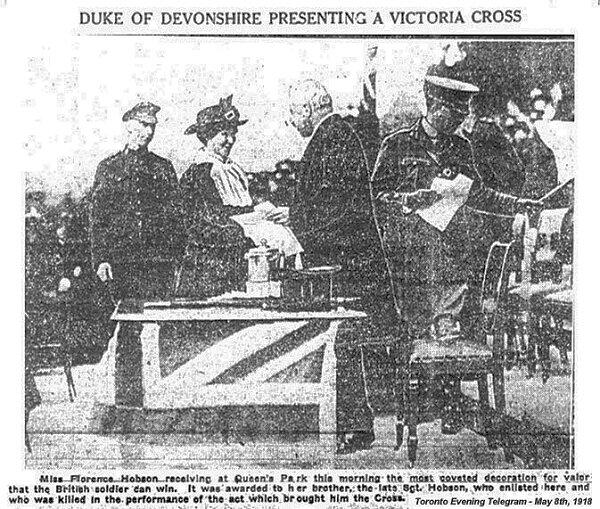
For his actions, Frederick Hobson was awarded the Victoria Cross posthumously, Canada’s highest recognition at the time for valour in the face of the enemy. His medal was later presented to his sister Florence by the Governor General, the Duke of Devonshire.
Hobson’s body was never recovered. His name is inscribed on the Vimy Memorial alongside thousands of other Canadians who died in France and have no known grave. Behind the extraordinary circumstances of his final action was a husband and father who had already served in one war, built a new life in Canada, and then volunteered to serve again.
Major Battles and Operations
- South African War, 1899 to 1902, with the 2nd Battalion, Wiltshire Regiment
- Western Front service, 1915 to 1917, with the 20th Canadian Infantry Battalion
- 255th Tunneling Company operations, 1916
- Battle of the Somme
- Battle of Hill 70, August 1917, where Hobson was killed in action and earned the Victoria Cross
Learn More
Canadian Virtual War Memorial, Sergeant Frederick Hobson
Veterans Affairs Canada, Frederick Hobson
Canadian War Museum, Frederick Hobson medal collection and biography
Western Front Association, Frederick John Hobson VC
Library and Archives Canada, Frederick Hobson service record
Badass of the Week, Frederick Hobson
http://legionmagazine.com/en/index.php/2005/03/hand-to-hand-on-hill-70/