
Service highlights
- Service Number: 769726
- Born: February 3, 1894 in St. Marys, Ontario.
- Enlisted: January 5, 1916 in Toronto, Ontario, service number 769726.
- Rank: Private, Canadian Infantry (Central Ontario Regiment), later serving with the 4th Battalion.
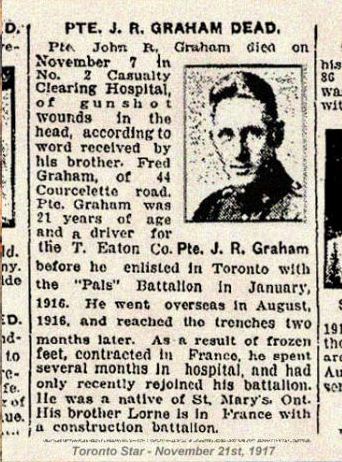
- Overseas service (local accounts): After training, local history sources describe him sailing for England in 1916, then being sent onward to France and joining his unit late in 1916. (Your newspaper clipping adds that he worked as a driver for the T. Eaton Company before enlistment.)
- Hardships noted in contemporary and local accounts: Treated after a gas exposure, later laid up for months with trench foot, then returned to the front in 1917.
- Died: November 7, 1917, age 23.
- Burial: Lijssenthoek Military Cemetery, grave XXI. GG. 10, in Belgium.
- Family (as recorded by VAC): Son of John Alexander Graham of Toronto.
A Life and Service Remembered
John Reginald Graham, known to friends and family as Jack, left home to serve at a time when the war was grinding down entire battalions and replacements were constantly needed. Jack enlisted in Toronto with the 124th and on Auguste 7th 1916 they sailed from Halifax on the SS Cameronia with his unit overseas, and the record of his service is marked by the very things that made the Western Front so punishing: gas, exposure, and long stretches of illness and recovery before being sent forward again.
As the need for reinforcements shifted, the 124th was broken up and Jack was transferred on 11 October 1916 to the 4th Canadian Infantry Battalion. Before joining his new unit, he spent close to three weeks at the Canadian General Base Depot at Le Havre, completing refresher training at the infamous “Bull Ring” or Central Training School. On 4 November 1916, he arrived at the 4th Battalion, which was then serving with the 1st Canadian Division in France.
His return to the front was cut short almost immediately. Soon after reaching the battalion, Jack was caught in a German tear gas attack and also came down with trench foot. He was admitted to the 3 Field Ambulance from 21 to 23 November 1916, and then evacuated to a Canadian General Hospital, where he remained until 28 April 1917. Even then his foot had not fully healed. He returned to the Canadian General Base Depot as a future reinforcement, and only at the end of August 1917 was he able to rejoin his battalion.
In October 1917, the 4th Battalion moved into the Ypres Salient for the grinding operations that culminated in the fighting at Passchendaele. On 6 November 1917, the 1st Canadian Infantry Brigade assaulted German trenches north of the village of Passchendaele, with the 4th Battalion held in reserve. Enemy artillery was active throughout the action. On 7 November 1917, Jack suffered a fractured skull from a German shell. He was evacuated through the mud to the rear, but died later that day at the 2 Canadian Casualty Clearing Station.
Jack was buried in Lijssenthoek Military Cemetery. He was predeceased by his mother, Margaret (Lee) Graham (1899). His father, John Alexander Graham, was listed as next of kin, and his brothers Fred, George, and Lawrence (Lorne) were serving with the Canadian Railway Troops. Jack is also commemorated on the St. Marys cenotaph.
Major Battles and Operations
- Ypres Salient operations, autumn 1917
- Passchendaele, 6 to 7 November 1917
- German gas attack and trench foot, November 1916
- Evacuation chain through field ambulance, hospital, and casualty clearing station
Learn More
https://www.veterans.gc.ca/en/remembrance/memorials/canadian-virtual-war-memorial/588623
https://canadiangreatwarproject.com/person.php?pid=24796
https://livesofthefirstworldwar.iwm.org.uk/lifestory/5905436
https://rcl236stmarys.ca/cenotaph/graham-lawrence-melvin/
Richard Holt, 769726 Private JR Graham, Pg 28