
Service highlights
- Service Number: 126605
- Born: 2 November 1890 in Port Elgin, raised in Kincardine
- Life in St. Marys: Barber by trade, played lacrosse with the St. Marys Alerts, member of St. James Lodge 73 AF&AM
- Enlisted: 17 September 1915 in the 71st Canadian Infantry Battalion
- Overseas: sailed from Halifax on SS Olympic, 1 April 1916
- Transferred: 28 May 1916 to the 73rd Canadian Infantry Battalion
- Died: 11 September 1916, a
- Buried: La Clytte Military Cemetery
- Legacy: the McConnell Club was named in his honour and continues to support the community
- Commemorated: Cenotaphs in St. Marys and Honored by family through the Veteran Banner Program
A Life and Service Remembered
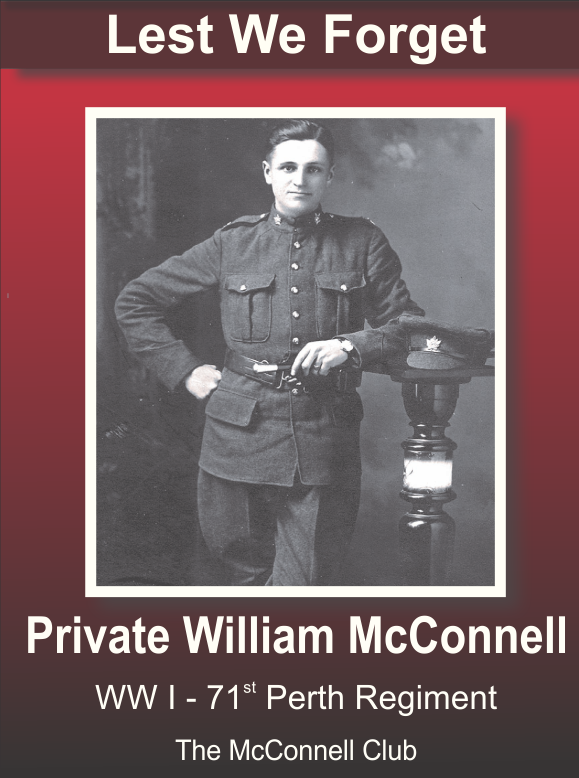
William John McConnell did not grow up in St. Marys, but St. Marys claimed him as one of its own. Born in Port Elgin and raised in Kincardine, he came to town in 1913 and quickly settled into the life of a busy, social community. He worked as a barber, a job that put him in the middle of everyday conversations and friendships. He played lacrosse with the St. Marys Alerts and was known around town as someone who belonged. When he enlisted in September 1915, people remembered him not as a name on a form, but as a familiar face.
His army path followed the pattern of many local men at first: enlistment, training, and months of waiting while the war moved faster than the paperwork. With the 71st Battalion he trained through the winter in Canada, then shipped overseas in the spring of 1916. After arriving in England and moving into further training, he was transferred to the 73rd Battalion, a unit that would soon be drawn into the hard realities of the front.
In August 1916 the 73rd crossed to France and entered the Ypres Salient. For new battalions, those early weeks were a harsh apprenticeship. Gas precautions were not theoretical. Steel helmets and drills were not routine. They were the difference between living and not. The battalion’s first occupation of the line came near Ypres in early September, and it did not take long for the front to reach into them. There were nights when mist and uncertainty turned every sound into a threat, and when alarms pulled men to the parapet before they fully understood what was happening.
On 10 September 1916 the 73rd were relieved in the front lines. Even a relief could be dangerous, especially when both units were inexperienced and the line was active. During that relief William was wounded, hit in the abdomen and head. He was taken back to the Regimental Aid Post, but his wounds were too severe. He died the next day, 11 September 1916.
In the town that had come to know him in such a short time, his death landed heavily. In the sources that describe local remembrance, he is referred to as the first “St. Marys boy” killed in action, not because he was born there, but because he had become part of the town’s fabric before he went overseas. That sense of ownership mattered, and it shaped what happened next.
Before the war even ended, commemoration in St. Marys was already taking shape through local groups that mixed social life with service. One of those groups began in the spring of 1914 as the St. Marys Girl’s Club, an informal circle that organized fortnightly dances for local bachelors. During the war, the club partnered with the Women’s Patriotic League, raising funds through dances, euchre parties, and catered banquets. They also did the quiet work that never made headlines but mattered to soldiers overseas, knitting socks, shirts, and pyjamas.
After William’s death, the club took on a commemorative purpose as well. It was renamed for him, as a way to keep his name present in the town rather than letting it fade into a list. The first reference to the McConnell Club under that name appears in March 1917, about six months after his death, when it was reported that a patriotic dance raised sixty dollars and that forty five dollars of it was given to the Women’s Patriotic League. The remembrance was not abstract. It was practical, public, and ongoing. His sister visited St. Marys in 1917 and expressed how glad she was that her brother had been so highly thought of.
That continuity is part of what makes William McConnell’s story unusual and deeply local. The club still exists today, continuing the same basic idea: neighbours supporting neighbours, with his name attached to that work. It provides financial support to those in need and meets on the fourth Wednesday of the month in the upper room at the St. Marys Library at 2 pm. In a town full of memorials carved in stone, the McConnell Club is a living one, carrying his memory forward through service rather than ceremony alone.
Major battles and operations
- Service in the Ypres Salient, August to September 1916
- Front line sector near Ypres, including early battalion reliefs where he was wounded (10 September 1916)
Learn More
https://www.veterans.gc.ca/en/remembrance/memorials/canadian-virtual-war-memorial/592349
https://canadiangreatwarproject.com/person.php?pid=25529
https://library2.smu.ca/bitstream/handle/01/30909/Azzano_Mark_MASTERS_2022.pdf?sequence=1&isAllowed=y
The Fallen by Richard Holt, 126605 Private W.J. McConnell pg43