

Service highlights
- Born May 27th 1898 (1900 according to census data)
- Service Number: 727784
- Known as: Cecil
- Enlisted: 20 April 1916, at St. Marys, with the 110th (Perth) Battalion,
- Sailed overseas: 31 October 1916, from Halifax on the SS Caronia, with his father Samuel and his brother William
- Posted in France: 22 April 1917, to the 4th Canadian Mounted Rifles near Vimy Ridge
- Role noted in unit: qualified as a bomber (grenade thrower)
- Wounded: 23 August 1917 at Lens, remained on duty
- Killed in action: 28 August 1918
- Burial: reinterred in January 1920 at Vis en Artois British Cemetery, Haucourt, France
A Life and Service Remembered
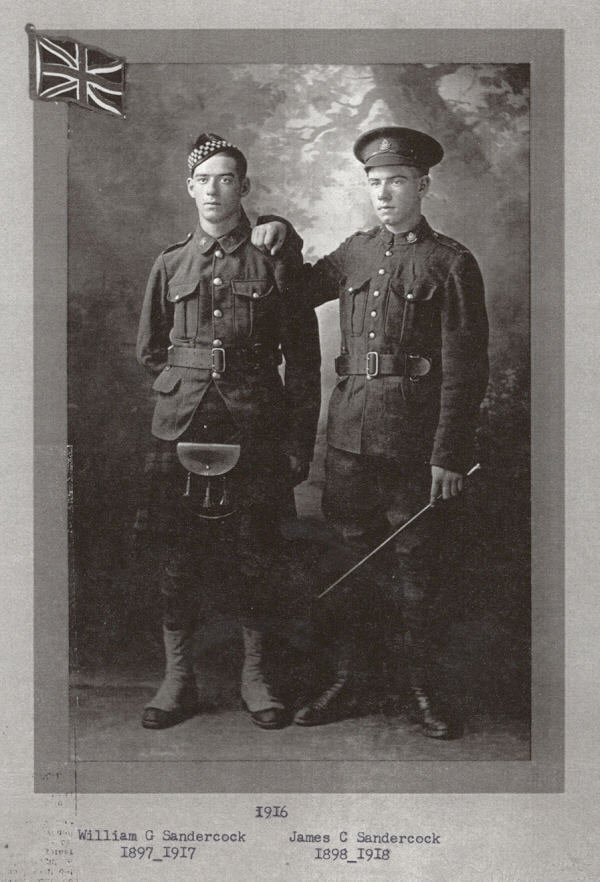
Cecil’s war begins too soon like so many others he was underage, but he wanted to go, to follow his Dad and his brother and so he enlisted in St. Marys with the 110th (Perth) Battalion. Before the war pulled him away, he lived with his family in town, first on Queen Street West and later on Salina Street, and worked as a machinist at Maxwell’s. Cecil was not an anonymous name in a distant list, he was a young man from a street, in a specific shop, in a small community where people would have known his face.
His story is also inseparable from his family’s. Cecil joined up in April 1916. William transferred into the 110th soon after, likely to serve alongside Cecil and their father Samuel. On 31 October 1916, the three sailed from Halifax on the SS Caronia. For a time, their war was shared in the most literal way, the same unit, the same ship, the same ocean crossing.
Overseas, the war began to separate them. The 110th was broken up for reinforcements, and Cecil went through the 8th Reserve Battalion for training. On 22 April 1917 he was posted to the 4th Canadian Mounted Rifles near Vimy Ridge, where the work was relentless even outside the famous set piece battles. Cecil qualified as a bomber, a role that demanded calm under pressure and put him close to the sharp edge of infantry fighting. His father Samuel had gone overseas with two of his sons but was forced home by illness.
Then came the day that forever tied the brothers’ stories together. On 23 August 1917, William was killed at Hill 70. Cecil was wounded at Lens that same day, but remained on duty. It is difficult to read that and not feel the emotional weight, a young soldier carrying on immediately after losing his brother, and doing so while hurt himself.
Cecil continued through 1917 and into 1918, fighting at Fresnoy, Lens and Passchendaele, and later through the Battle of Amiens in August 1918. He was killed on 28 August 1918 during an attack on the Fresnes Rouvroy line, between Boiry and the Cojeul River, a little over a year after William’s death. Cecil was buried on the battlefield, his grave marked by comrades, and later he was reinterred at Vis en Artois British Cemetery in France.
Cecil’s service tells a story of perseverance, and family tragedy that devastated his family. Both Cecil and William are commemorated on the Cenotaph in St. Marys.
Major battles and operations
- Vimy area service with the 4th Canadian Mounted Rifles, 1917
- Fresnoy, Lens, Passchendaele, 1917
- Amiens, 8 to 17 August 1918
- Fresnes Rouvroy line operations near Boiry and the Cojeul River, 28 August 1918
Learn More
- https://canadiangreatwarproject.com/person.php?pid=11957
- https://livesofthefirstworldwar.iwm.org.uk/lifestory/5688918
https://rcl236stmarys.ca/cenotaph/sandercock-private-samuel/
https://rcl236stmarys.ca/cenotaph/wm-g-sandercock/ - The Fallen, Richard Holt, 727748 Private JC Sandercock, Pg 62