
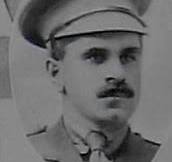
Service highlights
- Name: Everett Alexander Langford
- Rank: Lieutenant
- Born: 8 October 1879, Granton
- Occupation: steam engineer, worked in London
- Early service: joined a militia unit, 4 August 1915
- CEF attestation: 22 November 1915, Canadian Expeditionary Force
- Units: 135th Battalion (Middlesex), later 125th Battalion (Lanark and Renfrew), then 52nd Battalion (New Ontario)
- Overseas: embarked at Halifax on SS Olympic, 21 August 1916, arrived Liverpool 29 August 1916, then to Witley
- Killed: 8 August 1918, first day in action during the Battle of Amiens, near Hangard
- Burial status: originally reported buried at Hourges Orchard Cemetery, later listed with no known grave and commemorated on the Canadian National Vimy Memorial
- Commemorated: cenotaphs in St. Marys and Granton
A Life and Service Remembered
Everett Alexander Langford was born in Granton on 8 October 1879. As an adult he made his working life as a steam engineer and settled into London, living on High Street. When he joined the army, he was already established, with a trade, a home, and family ties that reached back to St. Marys.
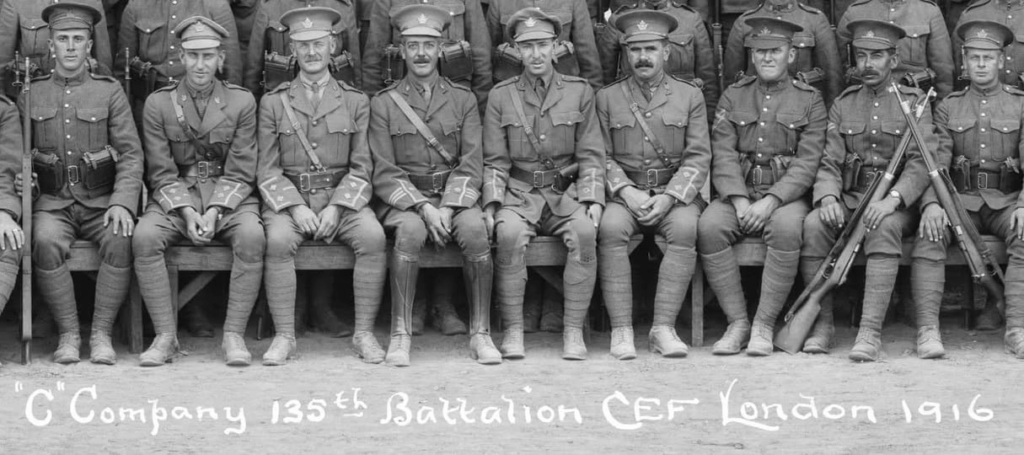
He first joined a militia unit in August 1915, then attested into the Canadian Expeditionary Force later that year. In the 135th Battalion he served with B Company, and he is remembered for recruiting heavily in the London and East Middlesex area, including the Parkhill region. Training was spread across local camps and courses before the battalion concentrated for more formal preparation, then sailed overseas in August 1916.
After arrival in England the 135th was gradually dissolved, its men redistributed as reinforcements. Everett was among those posted into the 125th Battalion at Witley in October 1916. In 1918, as Canadian authorities reorganized reinforcement streams, he was transferred again, eventually reaching the 52nd Battalion in France on 12 June 1918. The account suggests that, as a newly arrived officer, he likely took command of a rifle platoon of roughly forty to fifty men.
On 8 August 1918 the Canadian Corps attacked at Amiens, the opening of Canada’s Hundred Days. The 52nd were not in the first wave, but were in support, moving forward behind the assault and into a battlefield that was still under heavy fire. Everett was killed during his first day in battle. The official report stated that his skull was pierced by a splinter from an enemy shell as he was leaving the jumping off trench near Hangard, and death was instantaneous.
There has long been uncertainty about his grave. Contemporary reports recorded him as buried at Hourges Orchard Cemetery, and those reports were repeated in official registers. Years later a decision was made to commemorate him instead on the Vimy Memorial, and later reviews found nothing on record that confirmed a grave at Hourges Orchard. What remains is the certainty of his death, and the uncertainty that so many families carried afterward.
Everett was survived by his wife, Florence Mary Langford, and their daughter Florence, as well as his mother Adelaide Langford of St. Marys. He was also survived by two brothers, Oscar of St. Marys, and Percy, who was serving in France at the time. Family notes also mention that his medals, memorial cross, photographs, badges, and letters have been preserved, the kind of personal record that keeps a life from being reduced to a date and a line on a page.
Major battles and operations
- Reinforcement and training service in England, 1916 to 1918
- Battle of Amiens, 8 August 1918, opening of Canada’s Hundred Days
- Killed near Hangard while leaving the jumping off trench on the first day in action
Learn More
- https://recherche-collection-search.bac-lac.gc.ca/eng/Home/Record?app=pffww&IdNumber=512198&ecopy=447664a
- https://canadiangreatwarproject.com/person.php?pid=49413
- https://central.bac-lac.gc.ca/.item/?op=pdf&app=CEF&id=B5374-S020
- The Fallen by Richard Holt, Lieutenant E.A. Langford pg 37