
ervice highlights
- Service number: R/129636
- Born: 28 November 1910
- Work: Farmer
- Enlisted with the Royal Canadian Air Force on 2 October 1941 in London
- Trained as air gunner after initial pilot training, promoted Sergeant on 27 April 1942
- Posted to No. 428 Squadron RCAF on 10 November 1942, then to No. 405 Squadron RCAF on 27 April 1943
- Served as rear air gunner with Pathfinder operations from RAF Gransden Lodge
- Flew in Halifax II HR856 (code LQ-W) with 405 Squadron
- Missing, presumed killed, on operations to Turin on 16 to 17 August 1943
- Commemorated on the Runnymede Memorial, the cenotaph in Rannoch, the World War II plaque at St. Marys Town Hall, and the Bomber Command Memorial Wall in Nanton
A Life and Service Remembered
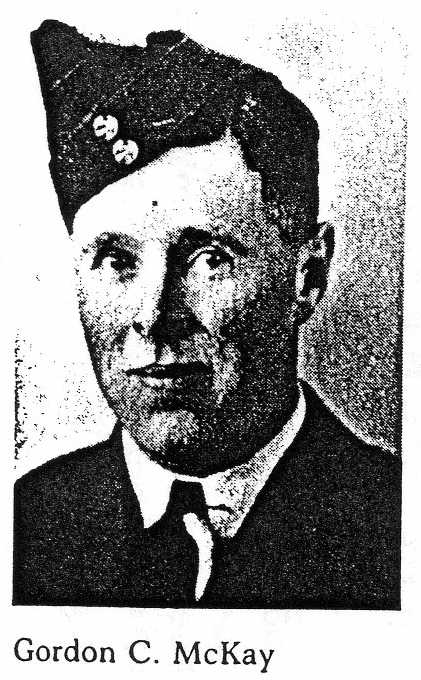
Gordon Campbell McKay was born near Science Hill on 28 November 1910. Before the war, his world was fields and livestock. He graduated from St. Marys Collegiate Institute in 1927 and poured his energy into the family farm, especially the Holstein herd he helped build and care for. Farming stayed close to him, even after he put on a uniform. While overseas he spent his leave time exploring the English countryside, watching how other farms worked, and studying dairy methods.
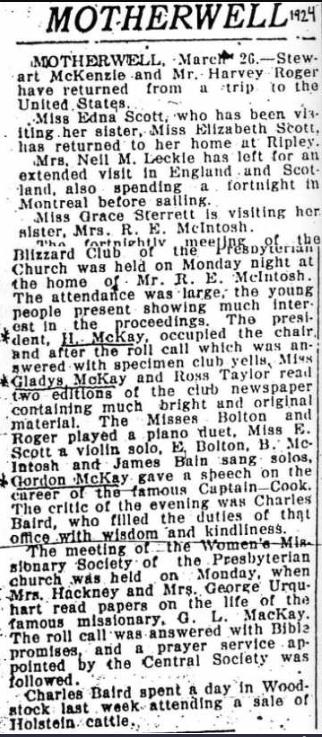
A small local newspaper item from the 1920s captures another side of him. At a church group gathering, young Gordon gave a talk on the career of Captain Cook. It shows he was the kind of person who would stand up at a community gathering and give a talk, even at a young age. That mix of steadiness and willingness to step forward shows up again in his wartime path. He enlisted in 1941, trained hard, and when pilot training did not work out, he shifted roles and carried on as an air gunner. That choice put him in one of the most dangerous jobs in the air war.
As a gunner, his job was to protect the crew and the aircraft, even when the aircraft could not be saved. By 1943 he had been selected into Pathfinder work, flying ahead of the main bomber stream to help mark targets at night. It was demanding flying done by crews expected to be accurate under pressure, and it speaks to the trust placed in him.
By 1943 he was flying with a Pathfinder squadron, marking targets for the main bomber force. On the night his aircraft failed to return, his family and friends were left without a gravesite to visit. What remains is his name, carried home by the places that still remember him and by the community that continues to speak it. He has been commemorated on the Runnymede Memorial, the cenotaph in Rannoch, the World War II plaque at St. Marys Town Hall, and the Bomber Command Memorial Wall in Nanton
Major battles and operations
Training and early service
- Enlisted in London, Ontario (2 October 1941)
- Basic training in Toronto, then posted to 14 Service Flying Training School at Aylmer
- Reassigned as an air gunner and completed air gunners training at 4 Bombing and Gunnery School at Fingal (spring 1942)
- Sailed for England (31 May 1942) and continued training with an operational training unit, including No. 23 OTU at Pershore, Worcestershire (as recorded in crew notes shared by the Manning family)
Operational squadrons
- 428 Squadron (Bomber), 6 Group
Served with 428 Squadron at Dalton, Yorkshire, flying Wellington aircraft. Crew notes shared by descendants of pilot Peter Manning record 14 operations during this period, with McKay as rear air gunner. - 405 Squadron, 8 Group (Pathfinder Force)
Posted to 405 Squadron in spring 1943 and based at RAF Gransden Lodge. Pathfinder crews marked targets using flares and coloured incendiaries so the main bomber force could aim more accurately. This work was carried out at night and often under heavy opposition, and it demanded high precision and calm under pressure.
Final operation
- Halifax II HR856 (LQ-W) departed on operations to Turin on the night of 16 to 17 August 1943. The aircraft was reported lost without trace. Contemporary and later research notes suggest the crew may have been shot down on the return trip.
- A local history source also records that by this stage McKay had completed 25 operations, reflecting the heavy tempo of his service.
Crew (as recorded in notes shared by descendants of F/O Peter Manning)
- Pilot: F/O Peter Manning
- Flight Engineer: Sgt Malcolm Stephen Miller R/73707 (from 24 May 1943)
- Navigator: F/O John David Hawkins J/16775
- Bomb Aimer: P/O William Edward Beavo J/18303
- Wireless Air Gunner: P/O Richard Alexander Carney J/17331 (from 20 July 1943)
- Mid Upper Gunner: P/O Frederick Harold Viney J/11355 (from 24 May 1943)
- Rear Air Gunner: Warrant Officer Class II Gordon Campbell McKay R/129636
All are commemorated at the Runnymede Memorial.
Learn More
Canadian Virtual War Memorial
https://www.veterans.gc.ca/en/remembrance/memorials/canadian-virtual-war-memorial/603763
Aircrew Remembered, Runnymede Database (search)
https://aircrewremembered.com/RunnymedeDatabase/?s=5300&q=Bomber%20AND%20Command&qand=&exc1=&exc2=&search_type=&search_only=
FamilySearch profile
https://ancestors.familysearch.org/en/LB9F-WWM/gordon-campbell-mckay-1910-1943
Rob Davis Telford, RAF Bomber Command casualties master list (M)
https://robdavistelford.co.uk/webspace/raf_bc/casualties-master-lists/casualties-master-list-m.html
Aircrew Remembered, Paradie Archive Database (search)
https://aircrewremembered.com/ParadieArchiveDatabase/?s=26000&q=440%20sqd%20rcaf&qand=&exc1=&exc2=&search_type=&search_only=
The Fallen by Richard Holt R129636 Warrant Officer Class II G.C. McKay, pg 117