
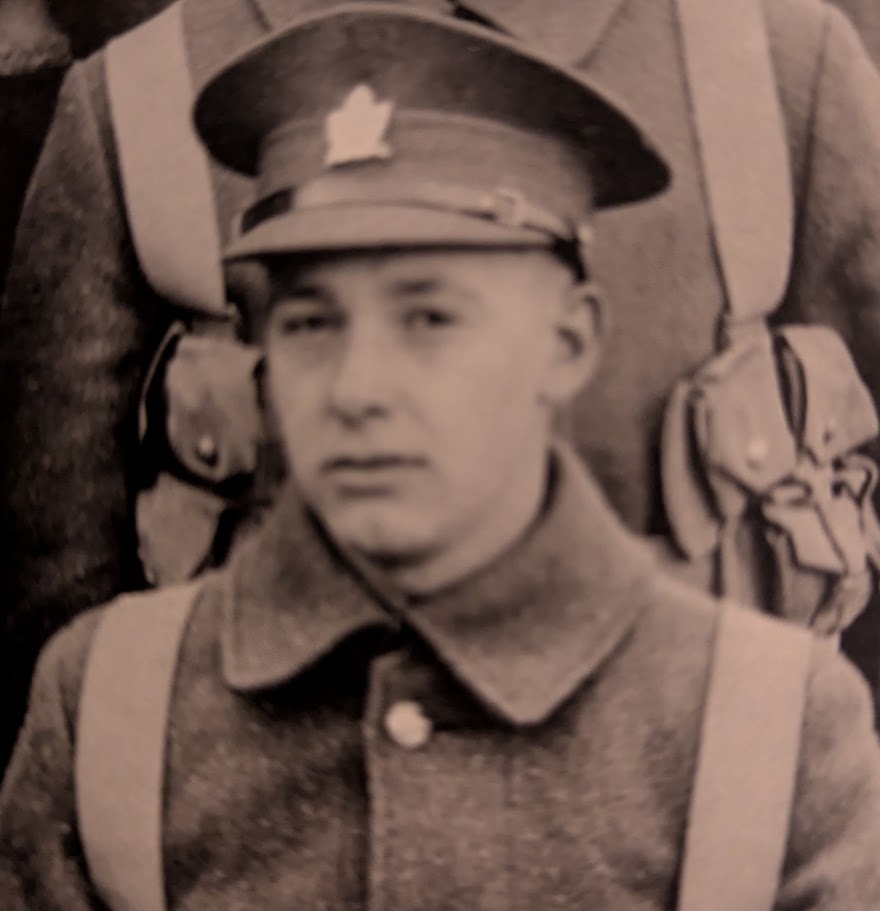
Service highlights
- Rank: Captain
- Born: 17 December 1917, St. Marys
- Education and work: Graduated from St. Marys Collegiate Institute in 1935, worked in the tobacco industry in Tillsonburg, later worked as a truck driver
- Early service and militia: Served with 3 (St. Marys) Company of the 2nd Battalion Canadian Machine Gun Corps, later with D (St. Marys) Company of The Perth Regiment
- Enlisted: 10 September 1939 as a private at Stratford
- Promotions: Corporal 16 March 1940, Sergeant 23 August 1940, Acting Captain 10 October 1944, confirmed Captain 20 June 1945
- Overseas: Sailed in 1941, arrived Liverpool 19 October
- Officer training: Posted to an Officer Candidate Training Unit 28 September 1942, graduated 1 February 1943, promoted to lieutenant 2 March 1943
- After the war: Volunteered for the Canadian Pacific Force and the Regular Force, repatriated 20 June 1945, later posted to Headquarters, Military District No. 1, demobilised and placed on leave 19 June 1946
- Died: 30 July 1947, after admission to Stratford General Hospital
- Burial and remembrance: Buried at St. Marys Cemetery and commemorated on a supplementary bronze plaque at St. Marys Town Hall
A Life and Service Remembered
Jack Franklin McKnight was born in St. Marys on 17 December 1917, and his early adult years were shaped by hard times. He graduated from St. Marys Collegiate Institute in 1935, right in the middle of the Great Depression, and like many young men he went wherever work could be found, first in the tobacco industry in Tillsonburg and later driving truck. Even then, the through line in his life was service. He was a keen militiaman, moving through local units before the war, including the Canadian Machine Gun Corps and then D Company of the Perth Regiment.
When the Perth Regiment mobilized, Jack enlisted on 10 September 1939. He was a natural Leader and promotions soon followed his enlistment, first to corporal in March 1940 and then to sergeant in August 1940, the kind of steady progression that usually meant people trusted him, relied on him, and saw leadership in him long before he wore officer rank. He sailed overseas with the regiment in 1941 and arrived at Liverpool on 19 October.
He was posted to an Officer Candidate Training Unit on 28 September 1942, on a path into the officer corps he graduated on 1 February 1943. His commission was not smooth and ceremonial. He was briefly hospitalized because of an accident on the grenade range, and then promoted to lieutenant on 2 March 1943.
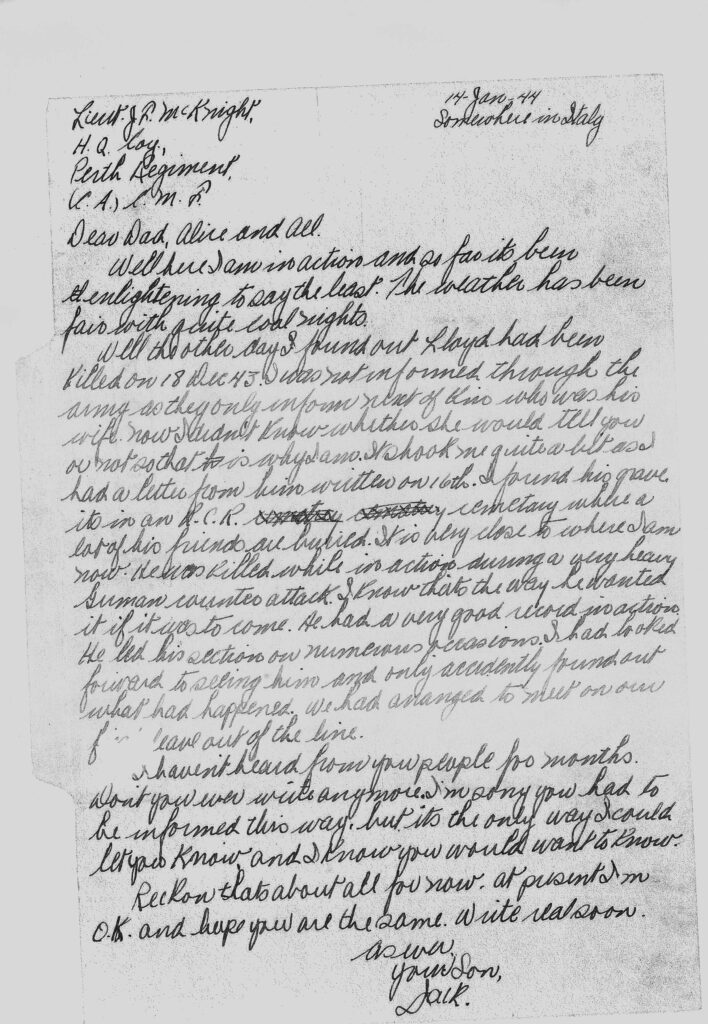
By October 1943, Jack landed in Italy with the Perth Regiment and served through the rest of the war in a variety of battalion appointments. One of the most personal glimpses into that period is a handwritten letter he sent home from San Donato in Italy on 14 January 1944. He wrote to his family about being in action and about the cold nights, but the heart of the letter is his brother Lloyd. Jack explained that he had only recently learned his brother Lloyd had been killed on 18 December 1943. He had not heard it through an official message, and the way he described it feels like a son trying to protect his parents while also needing to tell the truth. He wrote that he had found Lloyd’s grave while on duties, close enough that he could go and see it himself. He also wrote what he believed about Lloyd’s final moments, that he was killed during a heavy German counter attack, and that Lloyd had a good record and led his section on many occasions. It is the kind of letter that carries two burdens at once, war at the front and grief that followed him into the line.
Jack’s own war continued. He was promoted acting captain on 10 October 1944 and confirmed in that rank on 20 June 1945. At the end of the war he volunteered for the Canadian Pacific Force and the Regular Force, and he was repatriated ahead of the battalion on 20 June 1945. He was later posted to Headquarters, Military District No. 1, and finally demobilized and placed on leave on 19 June 1946.
The war did not end cleanly for him. The account states plainly that he was not a well man. He was eventually admitted to Stratford General Hospital, where he remained until he died on 30 July 1947. Later, the Canadian Pension Commission reviewed his case and ruled on 11 October 1947 that his death was related to military service.
Jack was buried in St. Marys Cemetery. He was survived by his wife and two children. His family remembers his courage and honors him through the Veteran Banner program and his name is engraved on a supplemental plaque along with the World War II plaque where his brother Lloyd is commemorated located on the South wall of St. Marys Town Hall.
Major battles and operations
- Overseas service with the Perth Regiment, including arrival in Liverpool in 1941
- Officer training and commissioning, 1942 to 1943
- Italy service with the Perth Regiment from October 1943 through the end of the war
- Promotion to captain and postwar repatriation, 1944 to 1945
Learn More
https://veterans.gc.ca/en/remembrance/memorials/canadian-virtual-war-memorial/649146
https://rcl236stmarys.ca/cenotaph/mcknight-lance-corporal-lloyd/
The Fallen, Richard Holt, Captain JF McKnight, Pg 118