
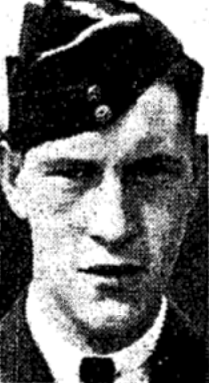
Service highlights
- Service number: J15927
- Born 5 December 1920 in Thorndale
- Attended school in St. Marys from 1927 to 1934 and at St. Marys Collegiate Institute from 1934 to 1939
- Enlisted in the Royal Canadian Air Force at London on 17 December 1940
- Sailed overseas 12 October 1941
- Served as a fighter pilot with No. 1 Squadron RAF and later with No. 245 Squadron RAF
- Awarded the Distinguished Flying Cross on 21 October 1943
- Flew Hawker Typhoon JP936 on his final operation
- Died 7 March 1945
- Buried at Reichswald Forest War Cemetery
- Commemorated on the World War II plaque at St. Marys Town Hall
A Life and Service Remembered
Known to many as “Moose,” Harrison Taylor Mossip grew up close to St. Marys and carried that small town grounding with him, even as his life took him far from home. He was born in Thorndale in 1920, went through elementary school in St. Marys, and attended St. Marys Collegiate Institute. He was remembered as a popular student and part of the Collegiate football team.
After graduation, he went where work was available, taking a job as a surface labourer with Consolidated Mining Limited in Northern Ontario. Not long after, he chose the air force. He enlisted in December 1940 and moved quickly through training, then crossed the Atlantic in October 1941.
His wartime service became defined by low level fighter operations, the kind that demanded nerve, precision, and a willingness to keep pressing in when the ground fire was heavy. He was the kind of man his unit was proud to serve with.
He joined the squadron late tin 1944 because of his experience and exceptional ability, he was made a Flight Commander within a fortnight. On 7 March 1945, flying Typhoon JP936, he led a formation from 245 Squadron alongside 175 Squadron on an armed rocket projectile reconnaissance in the Paderborn area. A circumstantial report written days later describes the action in detail: after attacking trains near Salzkotten, the formation descended through cloud and set up another low level run. During the attack, warnings were called about high tension wires. Moments later, his aircraft struck the wires, the starboard wing was seen to fail, and the Typhoon went in and hit the ground, killing him on impact.
On 21 October 1943 he was awarded the Distinguished Flying Cross for his performance as a fighter pilot. The citation credits him with pressing home repeated attacks with great determination in the face of heavy anti aircraft fire, including attacks that damaged nineteen locomotives and ten barges. A formal letter of congratulations was sent to Helen Mossip from the Minister of National Defence for Air, reflecting the pride held in his service record.
Another letter, written after his death, carries a different tone, personal and immediate, describing how deeply his squadron felt his loss and how quickly he had proven himself as a leader. He left behind Helen and their infant son, Richard Harris Mossip, in England, and his parents Henry and Eliza back in Thorndale. Today, his name remains part of the remembrance story at St. Marys, a link between home, service, and sacrifice.
Major battles and operations
Training and progression
- Enlisted 17 December 1940 and trained at multiple RCAF stations in Ontario, including Toronto, Picton, and Trenton.
- Completed flight training at 10 Elementary Flying Training School at Mount Hope, near Hamilton, and advanced training at 14 Service Flying Training School at Aylmer.
- Went overseas 12 October 1941.
- Posted to 1 Squadron RAF on 18 February 1942 as a sergeant pilot.
- Promotions recorded in the Holt account include Flight Sergeant on 1 July 1942, Pilot Officer on 9 November 1942, and Flight Lieutenant on 9 September 1944.
- Awarded the Distinguished Flying Cross
Squadrons and return to operationsm
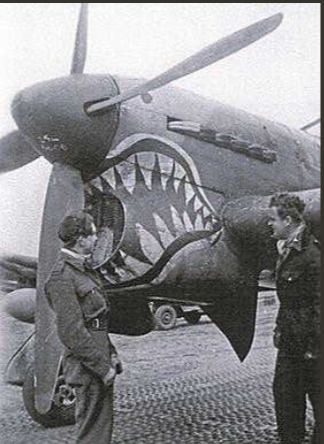
- On 25 February 1944 he was taken off combat operations for a rest.
- He returned to operations in November 1944, with a brief posting to No. 438 Squadron RCAF, then to 245 Squadron RAF on 19 November 1944.
- By March 1945, 245 Squadron was based in the Netherlands and flying armed reconnaissance missions into Germany.
- On his Typhoon JP936, he led a formation from 245 Squadron alongside 175 Squadron on an armed rocket projectile reconnaissance in the Paderborn Germany area.
- Records state that on his second tour he had completed 18 operational sorties and 18.35 operational hours.
Learn More
Canadian Virtual War Memorial
https://www.veterans.gc.ca/en/remembrance/memorials/canadian-virtual-war-memorial/638224
CASPIR unit search entry
https://caspir.warplane.com/personnel/unit-search/p/600014505/
Library and Archives Canada, service file record
https://recherche-collection-search.bac-lac.gc.ca/eng/home/record?idnumber=25885&app=kia&ecopy=44486_273022002859_0325-00147
Traces of War profile
https://www.tracesofwar.com/persons/61930/Mossip-Harrison-Taylor.htm
The Typhoon Project profile
https://www.thetyphoonproject.org/raf/Harrison%20Taylor-Mossip.html
Commonwealth War Graves Commission record
https://www.cwgc.org/find-records/find-war-dead/casualty-details/2040575/harrison-taylor-mossip/
Aircrew Remembered search page provided
https://aircrewremembered.com/AlliedLossesIncidents/?s=30300&q=440%20sqd%20(rcaf)&qand=&exc1=&exc2=&search_type=&search_only=
The Fallen, by Richard Holt, J15927 Flight Lieutenant H.T. Mossip, Pg 123