
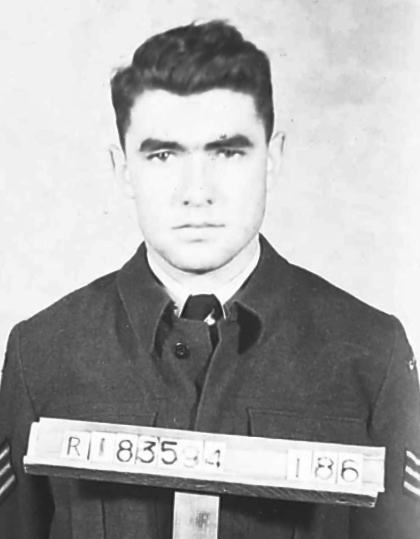
Service Highlights
- Service Number: J89037
- Born: 31 July 1923, Fullarton Township, Perth County, Ontario
- Family: Third of eight children of William Ellis Nairn and Adella Marguerite Bell; raised on the family farm near Science Hill and Rannoch
- Pre-war life: Farmer, truck driver and fur rancher who loved sports, hunting and building model aircraft
- Enlistment: 4 August 1942; Royal Canadian Air Force in London, trained as a pilot
- Aircrew training:
- 5 Manning Depot, Lachine, Québec
- 8 Service Flying Training School (pilot training)
- Re-mustered as an air gunner at No. 3 Bombing and Gunnery School, Macdonald, Manitoba, qualifying and being promoted Sergeant (Air Gunner) on 28 May 1943
- Overseas service:
- To England June 1943; 24 Operational Training Unit, then 1664 Heavy Conversion Unit at Dishforth, Yorkshire, converting to Halifax and Lancaster bombers
- Posted to 427 (Bomber) Squadron RCAF at Leeming on 19 September 1943; completed a full tour of 30 operations
- Transferred 11 May 1944 to 405 (Pathfinder) Squadron RCAF at Gransden Lodge, part of No. 8 Group RAF
- Helped mark targets with flares and coloured incendiaries ahead of the main bomber stream
- Awarded the Pathfinder Force Badge on 20 May 1944
- Commissioned as Pilot Officer on 23 August 1944
- Died: August 26 1944
- Commemorated: Runnymede Memorial in Surrey, England, & on the cenotaph at Rannoch, and on the Second World War plaque on the south wall of St. Marys Town Hall.
On the night of 25/26 August 1944, Pilot Officer Nairn was the air gunner in Lancaster PB233 on a raid against the Opel works at Russelsheim, Germany. On the return flight the aircraft was attacked by a German night fighter and badly damaged. Believing the burning Lancaster was about to crash, three crew members, including Ross, bailed out. The pilot, Flight Lieutenant Bill Weicker, then managed to regain control and nurse the crippled aircraft back to England.
The two other men who bailed out were later found alive and spent the rest of the war as prisoners of war. No trace of Ross Bell Nairn was ever officially found. He was 21 years old.
A Life & Service Remembered
Ross grew up in a close-knit farm family that had already known tragedy; an older brother, Aubrey, died in an accident in 1939. Friends and family remembered Ross as a capable young man who worked hard on the farm and on trucks and who threw himself into sports and outdoor life. His interest in aircraft began long before he enlisted, in the model planes he built as a boy in Fullarton Township.
When he enlisted in August he moved through to enter at 8 Service Flying training School but was not successful at becoming a pilot. So he pivoted and was sent to 3 Bombing and Gunnery School in MacDonald Manitoba. Once he completed his training he was promoted to Sergeant (Air Gunner). He quickly sailed to England and was posted to 24 Operational training unit to finish his training before final assignments.
Bomber Command service exposed him to continual danger and loss. During his time with 427 Squadron he survived a night crash in which his Halifax ran out of fuel over England after an attack on Berlin. In a letter home, he described climbing out of the burning wreck, then going back into the flames to lift the wireless operator onto his shoulders and carry him clear, while other crewmates were killed or fatally injured. He admitted that for days afterwards he shook uncontrollably, yet he chose to keep flying, later writing of attending funerals for fallen comrades and of the massive air and sea armada he saw on and after D-Day.
Ross and his crew volunteered for 405 Squadron as the crew’s gunner, the elite Pathfinder Force, accepting even greater risk so that other crews could find and hit their targets more accurately. By August 1944 he had flown roughly fifty operations over some of the most heavily defended targets in Europe. The operation was headed to Russelsheim, Germany, on a mission to attack the Opel factory there. On the return journey they were suddenly attacked by a German night fighter, the Lancaster was set on fire and badly damaged. Weicker then put the aircraft into a steep dive, in the confusion the crew prepared to bail, the steep dive worked it both extinguished the fire and helped him successfully escape further attack. During the chaos 3 crew members had bailed out, flight engineer Sgt. Kenneth Arthur Abbs, wireless operator Flt. Lt. Henry Donald Brown and Air gunner Pilot Officer Ross Bell Nairn.
What happened after he stepped out of Lancaster PB233 remains unresolved. Post-war investigations in the Homburg area uncovered the story of remains of an Allied airman in a forest crater, still wearing parachute harness and with a 9mm pistol bullet wound to the skull, strong evidence of a war crime. The body was then removed, possibly mis-identified and reburied elsewhere, and the trail went cold. Documents suggest it could possibly have been that the victim was Ross, but his identity was never conclusively proven. His parents, William and Adella, were officially told only that their son was missing and later presumed dead, and that “no trace” of him could be found. They carried that uncertainty for the rest of their lives.
Today Ross Bell Nairn is commemorated on the Runnymede Memorial in Surrey, England, which honours airmen with no known grave. He is remembered on his parents’ gravestone in Avonbank Community Cemetery, on the cenotaph at Rannoch, and on the Second World War plaque on the south wall of St. Marys Town Hall. Though his resting place remains unknown, his courage, his care for his crew mates, and the grief borne by his family are now part of our shared story.
Major Battles and Operations
- Strategic bombing campaign with 427 (Bomber) Squadron, RCAF – autumn 1943 to spring 1944
After completing training in the UK, Ross was posted to 427 (Bomber) Squadron RCAF in September 1943. Flying Halifax heavy bombers from Leeming in Yorkshire, he served as mid-upper air gunner in a regular crew under Pilot Officer William Arthur Cozens on night bombing operations over Germany. - Raid on Kassel – 3/4 October 1943
One of his early operations was a night raid on the industrial city of Kassel. Halifax LK626 was hit by anti-aircraft fire; the navigator was wounded, but Cozens and his crew, including Ross in the gun turret, brought the damaged aircraft safely back to Yorkshire. - Aborted raid on Leipzig – 3/4 December 1943
On an operation to Leipzig in Halifax DK181, the starboard inner engine failed and later caught fire. Cozens ordered his crew to bail out over Suffolk before force-landing the Halifax. All seven men, including Ross, survived. - Crash after Berlin raid – 20/21 January 1944
During a raid on Berlin in Halifax LL191, the same crew returned to England low on fuel and crashed while attempting to land near Coltishall, Norfolk. Civilians pulled the injured men from the burning wreckage. Four of the crew later died of their injuries; Ross and the wireless operator, Sgt H. P. Whittaker, survived but were badly hurt. - Pathfinder operations and D-Day support with 405 Squadron – May to August 1944
In May 1944 Ross transferred to 405 (Pathfinder) Squadron RCAF at Gransden Lodge, part of the elite Path Finder Force that marked targets for the main bomber stream.
In a letter home he described taking part in the D-Day operations, flying a bombing mission just before dawn on 6 June 1944 and watching streams of aircraft with gliders and the mass of invasion shipping in the English Channel below. - Attack on the Opel works at Russelsheim – 25/26 August 1944
Ross’s final operation was with Lancaster PB233 “LQ-O,” attacking the Opel factory at Russelsheim, an important target in the Ruhr-area industrial network. On the return leg the aircraft was attacked by a German night fighter, which set the rear fuselage and starboard wing on fire. The pilot, Flight Lieutenant William Jacob Louis Weicker, put the Lancaster into a steep dive that extinguished the flames and broke contact. In the chaos three crew members, including Ross, bailed out over Germany without orders, believing the aircraft doomed. Weicker regained control and brought the damaged Lancaster safely back to England; two of the men who jumped, Flight Lieutenant Henry Donald Brown and Sergeant Kenneth Arthur Abbs, became prisoners of war. Ross did not return and is commemorated on the Runnymede Memorial to those with no known grave.
Cozens Crew – 427 (Bomber) Squadron, RCAF
(Halifax LK626 – Kassel; DK181 – Leipzig; LL191 – Berlin)
From squadron accident reports and CASPIR, Ross flew as part of this regular Halifax crew in 1943–44:
- Pilot: Flying Officer William Arthur Cozens, RAFVR – killed from injuries after the Berlin crash, 21 January 1944.
- Navigator: Pilot Officer Laurence George Biddiscombe, RAFVR – wounded at Kassel, later returned to the crew; died of injuries after the Berlin crash.
- Bomb Aimer: Sergeant William Leslie Stockford, RAFVR – killed of injuries following the Berlin crash.
- Wireless Operator / Air Gunner: Sergeant H. P. Whittaker, RAFVR – survived the Berlin crash with injuries.
- Mid-Upper Air Gunner: Pilot Officer Ross Bell Nairn, RCAF – survived both the Leipzig bale-out and the Berlin crash; later posted to 405 Squadron.
- Rear Air Gunner: Sergeant C. Hopper, RAFVR – flew with the crew on Kassel and Leipzig; injured in the Leipzig bale-out and off flying duties for several weeks.
- Flight Engineer: Sergeant John McGowan, RAFVR – killed of injuries following the Berlin crash.
Weicker Crew – 405 (Pathfinder) Squadron, RCAF
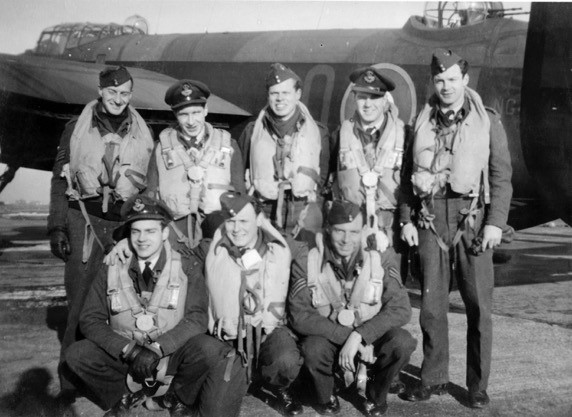
(Lancaster PB233 LQ-O – Russelsheim, 25/26 August 1944)
On his final mission Ross flew with this Lancaster crew from Gransden Lodge:
- Rear Air Gunner: Warrant Officer Maurice James Martin, RCAF – injured in the attack and landing but survived and returned to England.
- Pilot / Captain: Flight Lieutenant William Jacob Louis Weicker, RCAF – returned safely to base with the damaged Lancaster.
- Navigator: Flying Officer James Stewart McDowell, DFC, RCAF – survived and returned to Gransden Lodge.
- Bomb Aimer: Pilot Officer Edwin James New, RAF – survived and returned to Gransden Lodge.
- Wireless Operator: Flight Lieutenant Henry Donald Brown, RCAF – bailed out over Germany; taken prisoner of war and later repatriated.
- Flight Engineer: Sergeant Kenneth Arthur Abbs, RAF – bailed out over Germany; taken prisoner of war and later repatriated.
- Air Gunner: Pilot Officer Ross Bell Nairn, RCAF – air gunner who bailed out during the night-fighter attack and did not return; officially missing and commemorated at Runnymede.
Learn More
- Canadian Virtual War Memorial – Pilot Officer Ross Bell Nairn
https://veterans.gc.ca/en/remembrance/memorials/canadian-virtual-war-memorial/603340 - https://recherche-collection-search.bac-lac.gc.ca/eng/Home/Record?app=kia&IdNumber=26372&q_type_1=q&q_1=Nairn,%20Ross%20Bell&ecopy=44486_273022002859_0331-00179
- RCAF and squadron details (including crew lists and operations)
https://caspir.warplane.com/personnel/unit-search/p/600030132
https://caspir.warplane.com/personnel/unit-search/p/600026221 - Grave and family information
https://www.findagrave.com/memorial/176590033/ross-bell-nairn
https://www.selves.ca/getperson.php?personID=I22480&tree=tree1 - “Buried in Uncertainty: A Vanished Airman, a War Crime, and the Forgotten Mystery that Remains” – Following the Echoes (2025)
https://claudiafoxreppen.com/author/claudiafoxreppen/ - James R. Stevens, Dead Men Flying: Travelling with the Lost in Bomber Command
- Clint L. Coffey, The Job To Be Done: A Son’s Journey Into The Story Of A WW2 Bomber Command Aircrew
- Richard Holt, The Fallen, J89037 Pilot Officer R.B. Nairn, pg125