
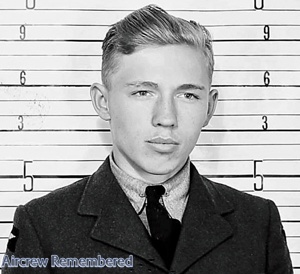
Service highlights
- Service number: R99568
- Born 27 November 1921 in Exeter
- Rank: Warrant Officer Class II
- Came to St. Marys as a young boy with his parents, Harold and Laura Pym
- His father was organist and choirmaster at Knox Presbyterian Church
- Enlisted: 14 April 1941 in the Royal Canadian Air Force at London
- Air gunner, promoted to Sergeant on 13 April 1942, later Warrant Officer Class II
- Served with No. 166 Squadron RAF (Tenacity) flying Wellington HF595
- Killed in action 4 July 1943, age 21, during night operations against Cologne, Germany
- Initially buried at Sint-Truiden, later reburied at Heverlee War Cemetery
- Commemorated on the World War II plaque at St. Marys Town Hall
A Life and Service Remembered
William Harold Pym’s early life carried him through several communities, but a thread of home and service runs through all of it.
He was born in Exeter, England, and came to St. Marys as a young boy with his parents. His father, Harold, served the community as organist and choirmaster at Knox Presbyterian Church, the kind of role that meant music on Sundays and steady commitment the rest of the week. William attended elementary school in St. Marys before the family moved on again, first to Listowel and later to the Wingham area.
He finished school during the Great Depression and did what many young men of that era did, he worked whatever jobs he could find. The Holt account notes farm work, ushering, and clerking. They are ordinary jobs, but together they paint a picture of someone willing to do his part and keep going.
When he enlisted in April 1941, he was still very young. Training took him from Ontario to England in just over a year. He became an air gunner, a role that demanded alertness, courage, and trust in the crew around him. By 1943 he was flying night operations in a Wellington bomber with 166 Squadron. On 4 July 1943, his aircraft was lost over Belgium on a mission against Cologne. He was 21.
He was buried at Sint-Truiden, Belgium, later exhumed and moved. His grave is now in Heverlee War Cemetery, among so many other airmen who never made it home. In St. Marys, his name remains part of our town’s remembrance, a life that began across the ocean, passed through our community, and ended in service far from home.
Major battles and operations
Training and path to overseas service
- Enlisted in London, Ontario on 14 April 1941 and completed initial training on 24 October 1941.
- Promoted to Sergeant on 13 April 1942.
- Reported to No. 4 Bombing and Gunnery School the next day and, after a short course, went overseas to England on 12 May 1942.
- In England, attended No. 7 Air Gunnery School and was posted to No. 28 Operational Training Unit on 18 August 1942, where he was assigned to a crew.
- Promoted to Warrant Officer Class II before joining No. 142 Squadron RAF on 4 November 1942.
- Transferred to 166 Squadron on 29 January 1943, equipped with Wellington bombers.
Final operation, 4 July 1943
- Aircraft: Wellington HF595
- Squadron: 166 Squadron (Tenacity)
- Task: night operations against Cologne, Germany
- Outcome: aircraft lost over Belgium, presumed enemy action. The Holt account notes the crash in Belgium and suggests a fighter attack, with wreckage found very near the large German fighter base at Sint-Truiden.
Crew of Wellington Mk X HF595
- Squadron Leader Pilot, Arthur Alan Cookson, RAF 40894
- Rear Gunner Flight Sergeant, William Harold Pym RCAF R/99568
- Navigator Flight Sergeant, James Crichton Clark DFM RAF 1343392
- Air Bomber Flight Sergeant, William Scarlett DFM RAF 1027850
- Wireless Operator Pilot Officer Ronald Stanley Rich RAF 139952
Learn More
- Canadian Virtual War Memorial
https://www.veterans.gc.ca/en/remembrance/memorials/canadian-virtual-war-memorial/668926 - Find a Grave
https://www.findagrave.com/memorial/14039109/william-harold-pym - Selves family tree page
https://selves.ca/getperson.php?personID=I13500&tree=tree1 - Aircrew Remembered, Paradie Archive Database (link provided)
https://aircrewremembered.com/ParadieArchiveDatabase/?q=Stinson%2C+Harold/ - Commonwealth War Graves Commission record
https://www.cwgc.org/find-records/find-war-dead/casualty-details/2777881/william-harold-pym/ - CASPIR unit search entry
https://caspir.warplane.com/personnel/unit-search/p/600016541 - RAF 166 Squadron site, grave locations
https://www.raf166squadron.com/GraveLocationP.htm - The Fallen, by Richard Holt, R99568 Warrant Officer Class II W.H. Pym, Pg 127