
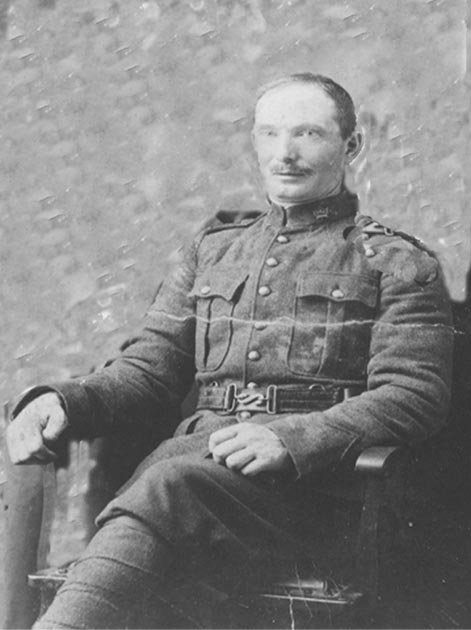
Service highlights
- Service Number: 401399
- Born in London, recorded as November 1872 in the 1911 census, and as 1875 in his service records.
- Immigrated to Canada with his family in 1898, and by 1908 had settled in St. Marys.
- Worked as a labourer for the Grand Trunk Railway.
- Enlisted 9 August 1915, with the 33rd Canadian Infantry Battalion.
- Posted to the 4th Canadian Infantry Battalion on 29 June 1916, then serving in Belgium.
- Died 9 September 1916.
- Buried at Sunken Road Cemetery, Contalmaison, France.
- Survived by his wife Emily Richardson of Queen Street West, St. Marys, and seven children, Charles, Charlotte, Emily, John, Amelia, James, and Henry, also recorded as Harry.
- Commemorated on the St. Marys cenotaph and at St. James Anglican Church, St. Marys.
A Life and Service Remembered
Charles Thomas Richardson was part of the working backbone of St. Marys. After arriving from England with his family, he settled on Queen Street West and worked as a labourer for the Grand Trunk Railway. He was a family man, and the records are clear about what he left behind, a wife, Emily, and seven children whose names were carefully listed.
When Charles enlisted in August 1915, he was not a young man looking for adventure. He was at least forty, and that matters because it changes how you read the decision. He trained with the 33rd Battalion through a difficult and public period in late 1915, when trouble in London brought unwanted attention to the unit and the men were stationed away for a time. Then, in the spring of 1916, he sailed from Halifax on the Lapland and was soon sent forward, first to the 4th Battalion in Belgium, then south into the Somme.
His early months in the trenches were in the Ypres Salient, but by late August 1916 the battalion was drawn into the Somme battle. Near Albert, and then in forward positions south of Courcelette, the 4th Battalion came under repeated shelling as the Germans tried to regain lost ground. Charles was not killed in a dramatic charge. He was killed the way many men were killed, by sudden heavy shellfire that gave no warning and no time.
A letter written days later by Sergeant Frank William Hames, a friend serving beside him, described being at Charles’s side when the shell hit and said he died instantly. He wrote that they had been together ever since Charles came out, and that losing him left him feeling alone. It is one of the few moments where the war stops being dates and movements and becomes what it really was, one man grieving another.
At home, the news arrived as a wire message. The local paper reported that he was survived by his wife Emily Richardson of Queen Street West, St. Marys, and seven children, Charles, Charlotte, Emily, John, Amelia, James, and Henry, also recorded as Harry. and that one son, Charles Jr., was also overseas. St. Marys carried his name onto the cenotaph and into the church, and the family carried the rest.
Major battles and operations
- Trench service in the Ypres Salient with the 4th Battalion, summer 1916.
- The Somme, late August to early September 1916, including support trenches near Albert and forward trenches south of Courcelette.
- German counter efforts and heavy shelling in early September 1916, when he was killed.
Learn More
https://www.veterans.gc.ca/en/remembrance/memorials/canadian-virtual-war-memorial/619029
https://canadiangreatwarproject.com/person.php?pid=38989
https://central.bac-lac.gc.ca/.item/?op=pdf&app=CEF&id=B8242-S045
https://pastvoices.com/canada/hames/
The Fallen, by Richard Holt, 401399 Private C.T. Richardson pg 56