
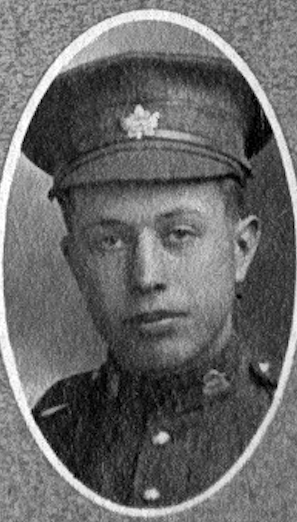
Service highlights
- Service number: 675096
- Born: 17 June 1897, Ratho, Oxford County, Ontario
- Worked as: Machinist, employed in a shell factory in Woodstock
- Enlisted: 8 January 1916, at Woodstock, with the 168th (Oxford) Canadian Infantry Battalion
- Overseas ship: SS Lapland, sailed from Halifax 30 October 1916, arrived Liverpool 11 November
- Transfers in England: First to the 39th Reserve Battalion, then to the newly formed 6th Reserve Battalion on 4 January 1917
- Front line unit: 21st Canadian Infantry Battalion, arrived with the unit in France on 20 March 1917, 2nd Canadian Division
- Wounded: 16 August 1917, gunshot wounds to the right thigh and left wrist
- Died of wounds: 18 August 1917
- Burial: Bruay Communal Cemetery Extension, France
- Remembered: Woodstock War Memorial
A Life and Service Remembered
George Frederick Steedsman was born on 17 June 1897 in Ratho, Oxford County. By the time he was 18, he was already doing skilled work as a machinist in Woodstock, in a shell factory that helped feed the war overseas. His days were spent shaping metal for the war effort, until the day came when he stepped forward to serve in uniform himself.
He enlisted at Woodstock on 8 January 1916 with the 168th (Oxford) Canadian Infantry Battalion. He trained through that winter, first in Woodstock, then with his battalion in London, Ontario, and at Camp Borden. Like many soldiers, he spent months preparing and waiting before the war became real in a way no training could fully match.
George sailed from Halifax on 30 October 1916 aboard the SS Lapland and arrived at Liverpool on 11 November. Once in England, his path followed the familiar reinforcement system. He was transferred first to the 39th Reserve Battalion and then, on 4 January 1917, to the newly formed 6th Reserve Battalion to complete infantry training. After that, he was posted to the 21st Canadian Infantry Battalion, then serving in France with the 2nd Canadian Division. He arrived at his new unit on 20 March 1917.
In the spring of 1917, George served with the 21st at the Battle of Vimy Ridge. A few months later he was involved in the fighting near Lens. In August 1917, the battalion was drawn into the hard battle around Hill 70. On 15 August, the 21st attacked as part of a Canadian Corps operation. Opposition was stiff, and on 16 August George was caught in the open by German machine gun fire.
He was admitted that day to 10 Canadian Field Ambulance with gunshot wounds to his right thigh and left wrist, then transferred to 22 Casualty Clearing Station. He died two days later, on 18 August 1917.
George was buried in the Bruay Communal Cemetery Extension in France. His headstone bears an epitaph chosen by his mother: “Blessed are the dead, who die in the Lord.” He was survived by his parents, William and Minnie Smith Steedsman of R.R. 1, St. Marys, and two brothers, David and William. The family story carried more hardship after the war as well, with William later dying of war related illness.
George is also commemorated on the Woodstock War Memorial. For the people who knew him, that memorial would not have been a distant symbol. It would have been a place where a familiar name, and a familiar face, had to be spoken in the past tense.
Major battles and operations
- Vimy Ridge, April 1917
- Fighting near Lens, June 1917
- Hill 70 operations, 15 to 18 August 1917
Learn More
https://veterans.gc.ca/en/remembrance/memorials/canadian-virtual-war-memorial/594583
https://21stbattalion.ca/tributeos/steedsman_gf.html
https://www.cwgc.org/find-records/find-war-dead/casualty-details/492747/george-frederick-steedsman/
https://canadiangreatwarproject.com/person.php?pid=31078
https://rcl236stmarys.ca/cenotaph/steedsman-trooper-william-john-james/
The Fallen, Richard Holt, Private GF Steedsman, Pg 68