
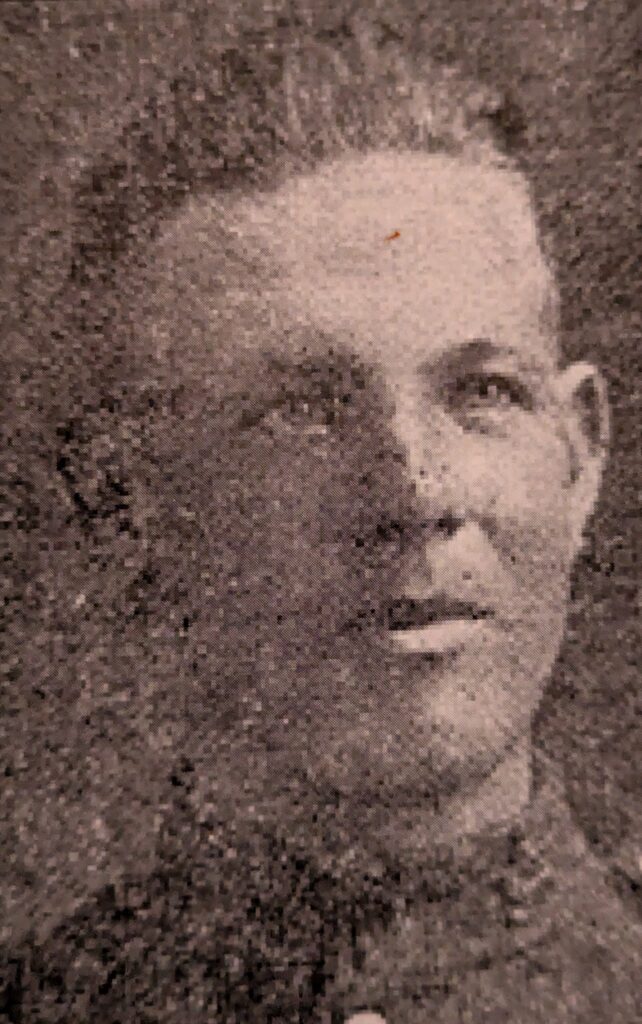
Service highlights
- Service number: 727649
- Born: 17 November 1893, near Kirkton
- Home and work: Farmer
- Enlisted: 2 March 1916 at Kirkton with the 110th (Perth) Battalion
- Appointed lance corporal: 11 November 1916, the day the ship docked at Liverpool
- Transferred: 1 January 1917 to the 8th Reserve Battalion at Shoreham
- Reverted to private: 25 June 1917 at his own request
- Posted to: 38th Canadian Infantry Battalion on 26 June 1917, serving with the 4th Canadian Division near Lens
- Awarded: Good Conduct Badge on 2 March 1918
- Died: 10 August 1918
- Battlefield burial: buried by comrades, later grave could not be found
- Commemorated: Vimy Memorial & on the cenotaph in Rannoch
A Life and Service Remembered
James Earl Roadhouse grew up near Kirkton and lived the steady rhythm of farm life in Blanshard Township. He was educated locally and worked the family land, a life built on early mornings, long seasons, and responsibility that did not wait.
When he enlisted in March 1916, he trained with the 110th Battalion across Stratford, London, and Camp Borden before crossing the Atlantic on the SS Caronia. There is a small, almost proud detail in his story: he was appointed lance corporal the day his ship reached Liverpool. It suggests he was seen as reliable, the kind of man others could be asked to follow.
The army shifted him into the reinforcement system in England, and then into France with the 38th Battalion. He served through Hill 70 and Passchendaele, then spent the winter and spring of 1918 doing routine tours in the Vimy sector. He earned a Good Conduct Badge in March 1918, a quiet mark of steadiness in a world that rarely stayed steady.
In August 1918, the Canadian Corps launched its great attack near Amiens. Two days later, as the 38th pushed forward again toward Hallu, the advance was slowed by heavy machine gun fire from the village of Lihons. Earl was hit, shot through the head and chest. A company stretcher bearer gave first aid, but he died almost immediately. He was buried on the battlefield by his comrades, but after the war the grave could not be found.
For his family, that meant there was no place at home that held him, only names and memory. His name is on the Vimy Memorial, and on the Rannoch Cenotaph, where people who knew his community kept him present in the way small towns do, by refusing to let the name fade.
Major battles and operations
- Service in the Lens sector with the 4th Canadian Division
- Hill 70, summer 1917
- Passchendaele, October and November 1917
- Winter and spring 1918 tours in the Vimy sector
- August 1918 operations following Amiens, including the advance toward Hallu and fighting influenced by machine gun fire from Lihons
Learn More
https://www.cwgc.org/find-records/find-war-dead/casualty-details/1573565/james-earl-roadhouse/
https://www.veterans.gc.ca/en/remembrance/memorials/canadian-virtual-war-memorial/617235
https://livesofthefirstworldwar.iwm.org.uk/lifestory/6079793
https://canadiangreatwarproject.com/person.php?pid=52525
https://central.bac-lac.gc.ca/.item/?op=pdf&app=CEF&id=B8313-S033
The Fallen by Richard Holt, 727649 Private J.E. Roadhouse pg 58